EN
EN
 ES
ES
 AR
AR


Article Overview: This guide helps procurement managers, sourcing teams, and project engineers build a t-shirt bag machine RFQ checklist that turns production needs into supplier-evaluation criteria. The core question is how to request comparable quotes before purchase. The conclusion is that a structured RFQ with verification checks reduces non-comparable bids and installation risk. The evidence boundary is published machine specifications and supplier demonstration guidance from the Lingfeng Machinery blog.
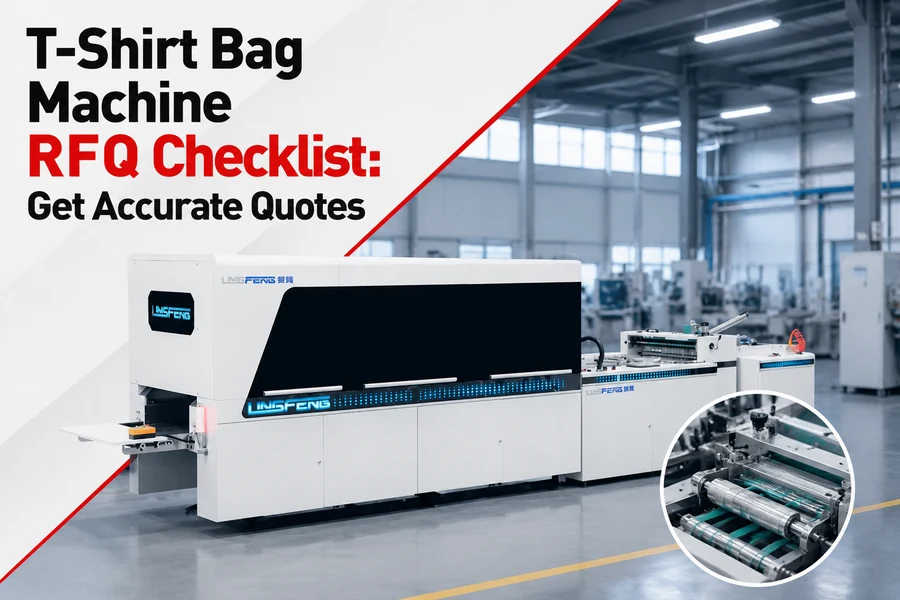
How Should Buyers Choose a T-Shirt Bag Machine RFQ Checklist?
Start with operating requirements, not machine brands: specify bag dimensions, film thickness, output rate, and facility limits so every supplier quotes to the same measurable baseline.
An RFQ is only as useful as the specifications behind it. When bag size and film thickness are missing, suppliers can quote machines with different sealing mechanisms, cutting systems, and speed ranges. The result is a set of bids that cannot be compared side by side. Hypothetical example: a buyer who sends only a t-shirt bag machine request without dimensions may receive quotes ranging from a compact single-lane line to a double-lane version; the differences are not necessarily defects, they are the result of missing parameters.
- Bag width, length, gusset depth, and handle cut-out dimensions
- Film type (HDPE, LDPE, or blends) and thickness in micron or mil with tolerance
- Required production speed in bags per minute and operating shift pattern
- Sealing method, such as hot bar or flying knife, and seal strength requirements
- Available floor space, power supply, air pressure, and operator skill level
- Integration with existing extruders, printing lines, or packing stations
After you define these parameters, document them in a format that all suppliers receive unchanged. The published t-shirt bag machine RFQ checklist guide walks through the same sequence and can help you avoid leaving out a critical dimension.
Step 1: Define Bag Dimensions and Thickness
State the exact bag width, length, gusset depth, and film thickness with tolerance. The RFQ process starts here because these values determine the machine's forming section and sealing tooling.
Step 2: Specify Film and Material
Indicate whether you will run HDPE, LDPE, or PLA/PBAT blends. Material choice changes seal temperature, knife behavior, and achievable line speed.
Step 3: Set Output and Facility Constraints
Define target bags per minute, operating hours, available floor space, power supply, and operator count. This separates a realistic quote from a theoretical one.
Step 4: Define Auxiliary Requirements
List take-away conveyors, packing tables, hole-punch units, or printing registration systems that must be included in the quote.
Using a standard flow-block like this keeps every supplier response on the same page. It also gives your internal team a clear baseline for later discussions about options and upgrades.
What Should Buyers Verify Before Ordering a T-Shirt Bag Machine?
Verify that the quoted machine has produced your exact bag geometry and film type in a documented run, and that acceptance criteria are included in the purchase agreement.
Supplier brochures describe capability, not your specific conditions. Buyers should ask for proof: test videos, sample bags, reference customers, and a written statement of what happens during factory acceptance. The supplier-evaluation guidance for bagging machines recommends requesting documented successful runs for the film types you plan to use.
| Verification area | What to request | Why it matters |
|---|---|---|
| Film compatibility | Documented runs with HDPE, LDPE, or PLA/PBAT at your thickness | Confirms the sealing system can handle the material you actually buy |
| Output rate | Measured bags per minute under continuous operation, not peak speed | Peak speed can differ from real-world cycle time with handling |
| Seal quality | Sample bags from a trial run with seal strength and visual inspection | T-shirt bags rely on the bottom seal to hold product weight |
| Changeover time | Standard procedure and time to switch bag sizes | Frequent size changes make quick changeover more valuable than top speed |
| Spare parts and support | Service response time, spare parts availability, and training plan | Downtime cost can exceed the initial price difference |
In addition to the table, define acceptance checks that will be used before payment is completed. A factory acceptance test should be run with your film and bag dimensions at the agreed speed. A sampling plan should state how many bags will be checked and which visual or seal defects are acceptable. Installation and commissioning terms should name who installs the machine, who trains operators, and who validates the first production run.
A supplier evaluation checklist for t-shirt bag making machines can help you organize these checks into a repeatable process for every candidate.
A quote that omits film type or bag dimensions is not necessarily a lower price; it is an incomplete specification. Ask for the same assumptions in every response, and treat missing data as a reason to request clarification.
Which T-Shirt Bag Machine RFQ Checklist Trade-Offs Matter Most?
The key trade-offs are output capacity versus capital complexity, film flexibility versus changeover speed, and automation level versus operator skill; the right balance depends on your production mix.
Procurement decisions are rarely about finding a single winner in absolute terms. They are about matching the machine to your order sizes, material range, and growth plan. Two common trade-offs come up in t-shirt bag RFQs: single-line versus double-line machines, and material-specific versus general-purpose configurations.
Single-Line vs Double-Line T-Shirt Bag Machine
Single-line machines produce one bag at a time and are easier to operate. Double-line machines process two lanes simultaneously and need more advanced controls.
- Single-line: Lower capital cost, simpler setup, typically up to 120 bags per minute for small to medium volumes.
- Double-line: Higher throughput without double the floor space, typically 200–300 bags per minute, with synchronized drives and more operator training.
Your decision depends on whether you need continuous high volume or flexible batch production.
Material selection is another trade-off that deserves its own RFQ line. The film type influences the sealing system, knife configuration, and speed settings. HDPE offers stiffness and lower material cost, but seal settings and knife wear differ from softer films. LDPE provides softness and tear resistance, but may require different temperature control and pulling systems. PLA/PBAT blends deliver compostability, but processing windows are narrower and documented runs are essential before you commit.
Think about how often you change materials. A machine that handles many film types usually needs more adjustment points, which increases changeover time. For example, if you run long production runs of one material, a dedicated setup may be more reliable. These trade-offs should appear explicitly in your t-shirt bag machine RFQ checklist so suppliers can price the configuration you actually need.
For a broader view of machine selection, the bag making machine procurement checklist covers additional parameters beyond t-shirt-specific details.
How Should Buyers Review Supplier Responses to the RFQ?
Compare responses against a pre-defined scorecard that weights speed, seal quality, support, and total ownership cost; do not let the lowest bid drive the decision alone.
Once all quotes arrive, resist the urge to compare total prices on the first page. Build a simple matrix with the same criteria you put in the RFQ. Include both quantitative values, such as speed, power, and floor space, and qualitative factors, such as documentation quality, response time, and willingness to run trials.
- Confirm the quoted output rate matches your target bag dimensions and film type.
- Check that every option and accessory is itemized, including installation and training.
- Request the acceptance protocol in writing before payment terms are finalized.
- Verify delivery lead time and how it changes if you modify bag size or material.
- Clarify spare parts policy and the location of the nearest service technician.
Use the same scorecard for every supplier. If a quote is missing a required specification, ask for the missing information before you compare prices. This prevents a supplier from offering a lower price that assumes a different bag geometry or material.
FAQ
Which specification should buyers define first in a t-shirt bag machine RFQ?
Bag width, length, gusset depth, and film thickness come first because they determine the machine's forming section, sealing width, and cutting system. Without these values, suppliers cannot provide comparable quotes, and the evaluation process becomes guesswork.
Should I choose a single-line or double-line t-shirt bag machine?
The choice depends on your production volume and order mix. Single-line machines are simpler and cost less, while double-line machines increase throughput without requiring twice the floor space. For example, if you run long, stable product lines, double-line may justify the added complexity.
Can the same machine process HDPE, LDPE, and biodegradable film?
Many machines can handle more than one material, but each film type changes seal temperature, knife behavior, and line speed. Before ordering, ask for documented runs at your specific thickness and treat multi-material flexibility as a separate verification item.
Conclusion: Use the Checklist to Remove Guesswork from RFQs
A t-shirt bag machine RFQ checklist is effective when it is specific, measurable, and shared with every supplier. Start with bag dimensions, film thickness, output rate, and facility constraints; then verify claims with documented trials and acceptance criteria; finally, weigh trade-offs such as single-line versus double-line and material flexibility. This reduces the chance of non-comparable quotes and post-installation surprises.