EN
EN
 ES
ES
 AR
AR


Article Overview: This article provides a practical, step-by-step t-shirt bag machine RFQ checklist for procurement managers, sourcing teams, and project engineers. Learn which technical parameters to include, how to evaluate supplier capabilities, and how to avoid common procurement mistakes. Use this guide to prepare accurate quote requests and reduce purchase risk.
Why Your T-Shirt Bag Machine RFQ Checklist Matters
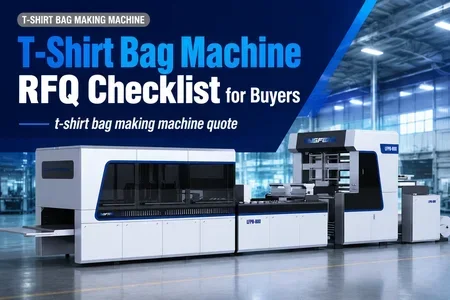
A well-structured RFQ (Request for Quote) is the foundation of successful capital equipment procurement. Without a comprehensive t-shirt bag machine RFQ checklist, buyers risk receiving vague or non-comparable quotes, hidden cost add-ons, and machines that fail to meet production requirements. A detailed checklist ensures that every supplier responds to the same specifications, making it easier to compare prices, delivery times, and after-sales support. Moreover, it forces internal teams to clarify production parameters upfront, reducing the likelihood of costly rework or delays after installation.
Consider a typical scenario: a buyer sends a brief request for a “t-shirt bag making machine” without specifying bag size or film thickness. Suppliers may quote machines with vastly different capabilities, leading to confusion and wasted negotiation time. By contrast, a structured t-shirt bag machine RFQ checklist aligns all parties on critical requirements and accelerates the procurement cycle.
Step 1: Define Bag Dimensions and Thickness
Start by specifying the exact bag width, length, and gusset depth (if applicable). Also include the film thickness (micron or mil) and tolerance range. For t-shirt bags, the cut-out shape and handle style should be clearly described or referenced to a standard design.
Validation: Confirm that your target bag dimensions match the machine’s maximum and minimum adjustable ranges. Many machines use interchangeable forming plates for different handle shapes; ensure compatibility.
Step 2: Specify Material Type and Properties
Identify the resin type (e.g., HDPE, LDPE, LLDPE, or blends) and any additives (e.g., UV stabilizers, anti-block, slip). Also state whether you require a printed or unprinted bag, and if printing is needed, specify the number of colors and registration tolerance. If you plan to use recycled material or biodegradable films, note the permitted percentage and any special processing requirements.
Validation: Ask suppliers if their machine’s sealing system, screw design, and temperature control can handle the exact material blend you intend to run. Some machines require minor modifications for certain additives.
How to Build Your T-Shirt Bag Machine RFQ Checklist
Below are the essential categories to include in your t-shirt bag machine RFQ checklist. Use this as a template when requesting quotes from suppliers.
- Production Output: Desired bag-per-minute rate, shift hours, and annual volume. Include any planned future expansion.
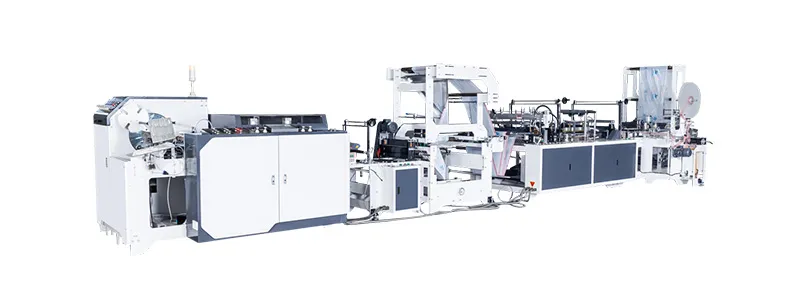
- Line Configuration: Single-line or multi-line? Inline printing, embossing, or perforation? Stacking or winding? Specify stacker type (e.g., batch counter, conveyor) and packaging method.
- Power and Utilities: Voltage (e.g., 380V/50Hz or 480V/60Hz), phase, compressed air pressure, and cooling water requirements.
- Automation Features: Servo drives, PLC controls with touchscreen, automatic tension control, and fault detection systems.
- Certifications and Standards: CE, UL, ISO, or other regional marks required for your destination market.
- After-Sales Support: Warranty period, spare parts availability, remote diagnostics, and local service network.
By including these items in your RFQ, you reduce the chance of receiving incomplete or non-comparable quotes. Many suppliers also provide a standard quote form; cross-check it against your checklist to capture all relevant data.
How to Evaluate Supplier Capabilities
An RFQ is only as good as the suppliers you send it to. The following flow outlines a systematic evaluation process:
Phase: Pre-Qualification
Screen suppliers based on production capacity, experience with t-shirt bag machines, and references from similar projects. Request a list of installed machines in your region or industry vertical. Verify that the supplier can meet your required delivery timeline and that their after-sales team can support your location.
Action: Send a short preliminary RFQ to 3–5 suppliers. Use the responses to shortlist those who demonstrate clear understanding of your parameters and offer competitive terms.
Phase: Technical Comparison
Once you receive full quotes, compare them against your checklist. Pay attention to machine base specifications, optional features, and exclusions. For critical parameters like bag width range or sealing temperature limits, ask for written confirmation. If possible, request a machine trial or visit an existing production site.
Validation: Use a weighted scoring system (e.g., price 40%, technical fit 30%, after-sales support 20%, delivery 10%) to rank suppliers objectively.
Common Procurement Mistakes and How to Avoid Them
Even with a good t-shirt bag machine RFQ checklist, buyers can fall into these traps:
- Omitting destination market requirements: Forgetting to specify voltage, frequency, or safety certifications can lead to expensive modifications later. Always include target country and any mandatory standards.
- Focusing only on initial price: A cheap machine may have higher operating costs (e.g., energy consumption, downtime, spare parts). Calculate total cost of ownership over 3–5 years.
- Ignoring film roll core size: The machine’s unwinding system must match your film supplier’s roll dimensions (core diameter, max roll width, weight). Mismatch causes jams or reduced efficiency.
- Underestimating installation and training needs: Factor in costs for shipping, import duties, site preparation, electrical installation, and operator training. Some suppliers include these in the quote; others do not.
- Not validating with a sample run: Before full production, conduct a sample run using your actual bag film and print design. This verifies machine performance and print registration.
By being aware of these pitfalls upfront, you can adjust your t-shirt bag machine RFQ checklist to ask targeted questions that prevent surprises.
FAQ
What is the most important parameter in a t-shirt bag machine RFQ?
Bag dimensions and film thickness are the most critical because they directly affect machine design, sealing system, and output rate. Suppliers need precise values to recommend the correct model and avoid performance issues.
How many quotes should I request?
Typically, 3–5 quotes provide a balanced view of the market without overwhelming your evaluation process. This range allows you to compare pricing, technical capability, and service levels.
Should I include future production plans in the RFQ?
Yes. If you anticipate higher volumes or new bag styles within 2–3 years, mention these in your t-shirt bag making machine quote request. Suppliers may suggest a modular machine that can be upgraded later, saving capital expenditure.
Can I use the same RFQ checklist for other bag types?
While many parameters overlap (e.g., dimensions, material, power), bag type-specific features such as handle design, sealing pattern, and stacking method must be adapted. For t-shirt bags, focus on cut-out shape and handle reinforcing if required.
What should I do if supplier responses are inconsistent?
Host a clarification round. Send a summary of discrepancies and ask each supplier to confirm or correct their figures. This often reveals which ones have a deeper understanding of your requirements.
Conclusion
A thorough t-shirt bag machine RFQ checklist is an indispensable tool for procurement managers and project engineers. It reduces information asymmetry, ensures comparable quotes, and minimizes the risk of costly procurement errors. By systematically defining bag dimensions, material properties, production output, automation needs, and after-sales expectations, buyers can confidently evaluate suppliers and select the right machine for their operation. For a practical starting point, review the t-shirt bag machine RFQ checklist provided by Lingfeng Machinery, or use this guide to build your own. Always test assumptions through sample runs and third-party references to validate supplier claims. With careful preparation and a structured approach, your next t-shirt bag machine investment will deliver long-term value and operational reliability.