EN
EN
 ES
ES
 AR
AR


Article Overview: Selecting between a single line vs double line t-shirt bag machine is a critical decision for bag manufacturers. This comparison explores output capacity, capital investment, operator requirements, and maintenance trade-offs. We provide evaluation criteria, specification differences, and decision guidance to help you choose the right t-shirt bag making machine for your production goals.
When shopping for a single line vs double line t-shirt bag machine, manufacturers must weigh several factors. Single line machines offer simplicity and lower initial cost, while double line machines deliver higher throughput per floor space. This article compares both configurations objectively, covering performance, cost, and application fit.
What Are Single Line and Double Line T-Shirt Bag Machines?
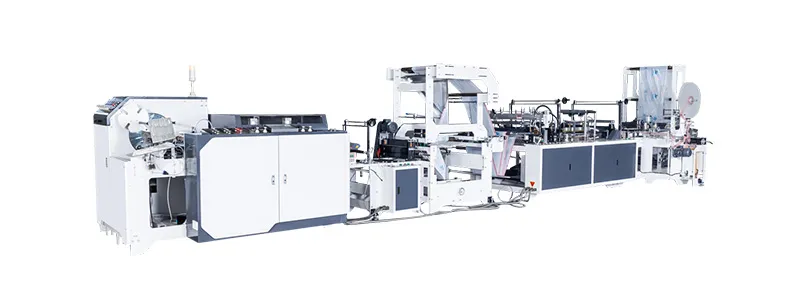
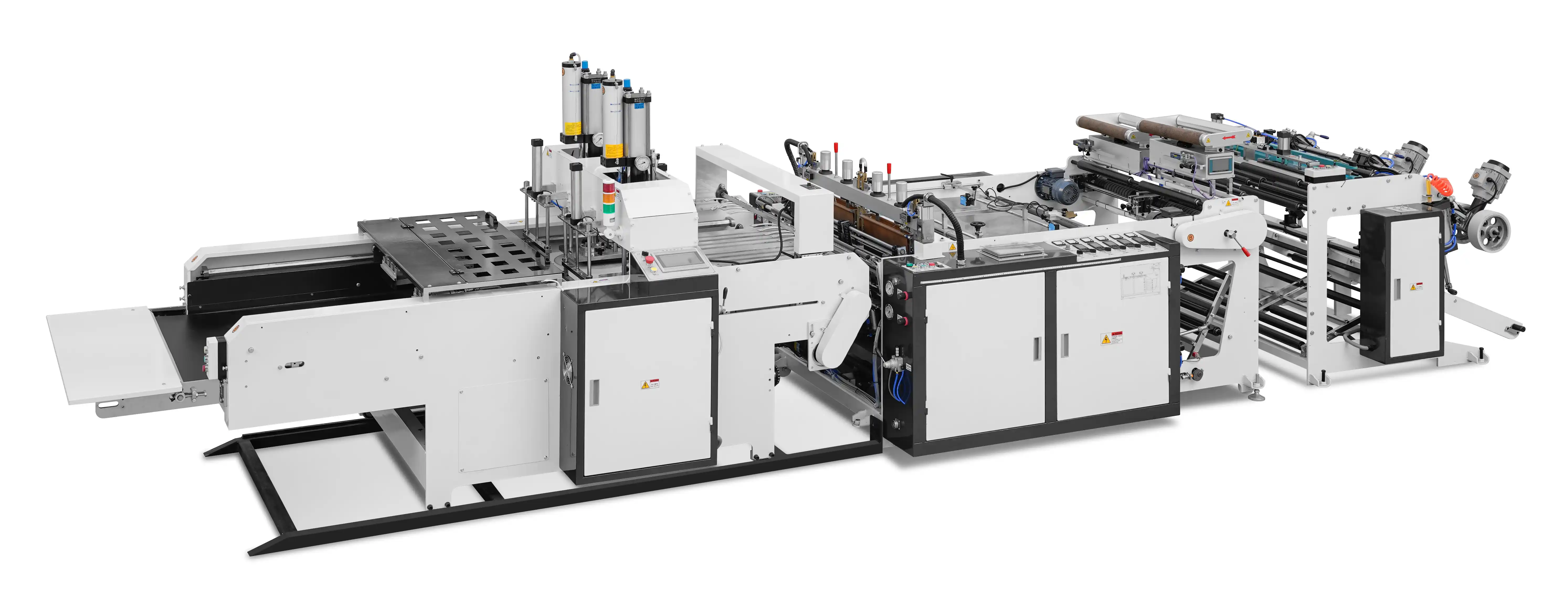
A single line t-shirt bag machine produces one bag at a time from a single web of film. It typically operates at speeds up to 120 bags per minute and is ideal for small to medium production volumes. A double line t-shirt bag making machine processes two lanes simultaneously, doubling output to 200–300 bags per minute without requiring twice the floor space. The double line design uses synchronized drives to maintain consistent sealing and cutting across both lanes.
Both types convert LDPE or HDPE film into t-shirt/vest bags. The key difference lies in the number of production lanes and the corresponding mechanical complexity. Single line machines are easier to set up and operate, while double line machines require more advanced controls and operator training.
Single Line vs Double Line T-Shirt Bag Machine: How Do They Compare?
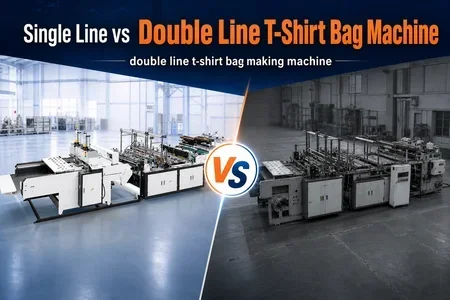
To make an informed decision, evaluate these five criteria: output, investment, space utilization, operator skill, and maintenance. Below are detailed comparison blocks.
Option A: Single Line Machine
- Output: 80–120 bags/min, suitable for daily production of 30,000–50,000 bags
- Investment: Lower purchase price (approx $10,000–$20,000 less than double line)
- Operator: One operator can run 1–2 machines
- Space: Compact footprint, easy to fit in small workshops
- Best for: Start-up operations, low-volume custom runs
Option B: Double Line T-Shirt Bag Making Machine
- Output: 200–300 bags/min, doubling daily capacity to 100,000+ bags
- Investment: Higher initial cost but lower cost per bag
- Operator: One skilled operator can manage one machine; some models allow one operator to run two double line machines with automation
- Space: Approximately 1.5x the footprint of a single line, but doubles output
- Best for: High-volume production, contract bag manufacturers
Specification Comparison Table
| Parameter | Single Line Machine | Double Line Machine |
|---|---|---|
| Max bag width | 12–20 inches | 10–18 inches per lane |
| Max bag length | 8–28 inches | 8–28 inches |
| Film thickness range | 0.01–0.08 mm | 0.01–0.08 mm |
| Servo motor | Optional | Standard for each lane |
| Photocell registration | 1 sensor | 2 sensors (one per lane) |
| Sealing type | Hot knife, impulse, or ultrasonic | Hot knife or servo-driven impulse |
| Power consumption | 4–6 kW | 8–12 kW |
| Air consumption | 0.3 m³/min | 0.6 m³/min |
Note: Actual specifications vary by manufacturer. Always request datasheets for the exact model you are considering.
Which Machine Suits Your Production Volume?
The volume decision depends on your daily bag requirement and growth plans. For a small shop producing under 50,000 bags per day, a single line vs double line t-shirt bag machine debate tilts toward the single line for lower risk and faster payback. As demand exceeds 100,000 bags daily, the double line t-shirt bag making machine becomes more cost-effective due to lower labor per bag and higher throughput.
Buyer Note: Scaling Up
If you plan to grow from a single line to a double line later, consider a machine that can be upgraded. Some manufacturers offer convertible frames. Alternatively, start with one double line on a smaller servo configuration to leave room for expansion without replacing the entire line.
Key Considerations Before Buying
- Material Type: HDPE runs faster but requires consistent tension control. LDPE is more forgiving on single lines.
- Bag Design: Complex die-cut handles may need more precise registration; double line machines with independent lane controls handle this better.
- Operator Training: Double line machines demand familiarity with two sealing and cutting systems. Budget for training time.
- Maintenance Parts: Double line requires duplicate parts (sealing bars, cutting blades). Single line inventory is simpler.
Common Applications
Single line machines are popular for retail store bag production, small grocery chains, and custom-printed bags with short runs. Double line machines dominate large distribution centers, industrial bag suppliers, and operations running 24/7. Both can produce standard T-shirt bags, vest bags, and bags on roll. For the latter, the single line vs double line t-shirt bag machine decision also affects winding options; double lines often integrate dual rewinding stations.
FAQ
How do I decide between a single line vs double line t-shirt bag machine for a new factory?
Assess your target output. If you expect to produce less than 1 million bags per month, start with a single line. For 2–3 million bags per month, invest in a double line t-shirt bag making machine. Also factor in floor space and available electrical capacity.
Can a double line machine run single lane when demand drops?
Yes, most double line machines can operate with one lane disabled. However, efficiency may drop slightly due to unbalanced tension. This flexibility makes double line machines more adaptable to fluctuating orders.
What maintenance differences exist between single and double line machines?
Double line machines have twice as many sealing and cutting components, so maintenance frequency is higher. However, many modern double line machines use modular designs that speed up part replacement. Single line machines are simpler but may require more frequent adjustments for consistent bag quality.
Is a single line vs double line t-shirt bag machine more energy efficient?
Per bag produced, double line machines are more energy-efficient because the base load (control box, air compressor) is shared across two lanes. A single line uses slightly more energy per bag due to overhead. Example: a double line consuming 10 kW produces 250 bags/min (0.04 kWh per bag) vs single line 5 kW producing 100 bags/min (0.05 kWh per bag).
How does the learning curve compare?
Single line machines can be mastered in 1–2 weeks. Double line machines require 3–4 weeks of supervised operation, especially for setting servo parameters and synchronizing lanes. Factor this into your startup timeline.
Conclusion
Choosing between a single line vs double line t-shirt bag machine ultimately comes down to production volume, budget, and growth plan. Single line machines offer lower upfront cost and simplicity, making them ideal for emerging businesses. Double line t-shirt bag making machines provide higher throughput and better cost efficiency for high-volume operations. Evaluate your current and projected bag output, test machines if possible, and consult with suppliers about upgrade paths. By aligning the machine type with your production goals, you can optimize both your capital investment and operational efficiency.