
You are running a bag making line, and something is not quite right. The film edge drifts a few millimetres to one side, then comes back. Seals on one edge look slightly different from seals on the other. On printed film, the handle punch lands a little off-centre on some bags but not others. The machine still runs. The bags still ship. But the operator is spending time nudging the unwind stand, and the scrap bin is filling faster than it should. EPC — Edge Position Control — is the subsystem designed to remove that drift. What it actually does, and whether it justifies its place on your machine specification, depends on what you are running and how much that drift is costing you. This article explains EPC in plain operational terms: the mechanism, the failure modes it addresses, the economic case, and the diagnostic steps for deciding whether your line needs it.
For the broader context of how individual machine features fit into a complete purchasing decision, the general selection guide on plastic bag machine types covers bag type, film compatibility, lane count, and supplier evaluation. This article focuses specifically on EPC as a web-handling function.
EPC stands for Edge Position Control. Its job is narrow and precise: keep the film web at a fixed lateral position as it travels from the unwind roll through the sealing and cutting stations.
The mechanism is a closed-loop system. A sensor — typically a photoelectric edge detector — continuously monitors the position of the film edge. When the edge moves, the sensor sends a position-error signal to a controller. The controller commands an actuator, usually a servo motor driving a guide roller or the unwind stand, to shift the web back to the target position. The correction is continuous and automatic.
What makes EPC different from a fixed edge guide is the feedback loop. A fixed guide — a flange or a roller shoulder — constrains the film only while it is in contact with the guide. Once the film leaves the guide, it can drift again. EPC corrects the position at the point of measurement and maintains it through the downstream web path. The practical result is that the film edge stays where the sealing and punching stations expect it to be, rather than wandering within a tolerance band that the operator learns to work around.
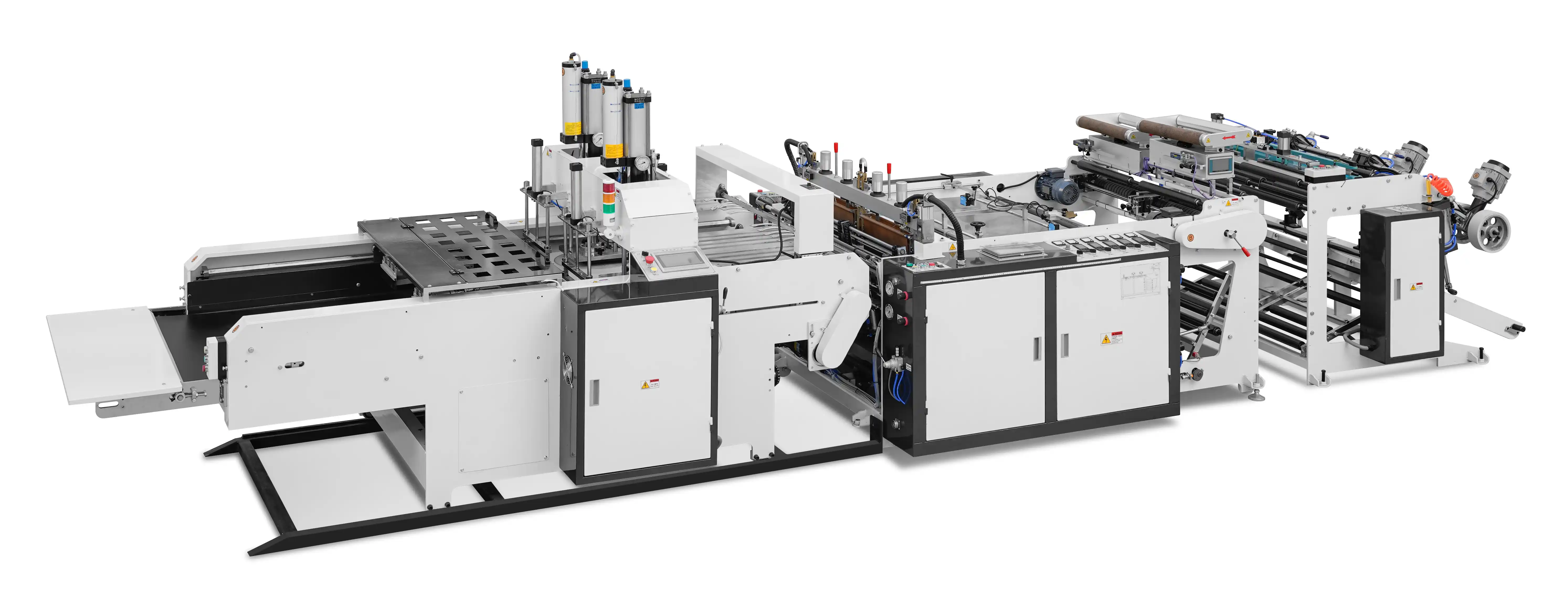
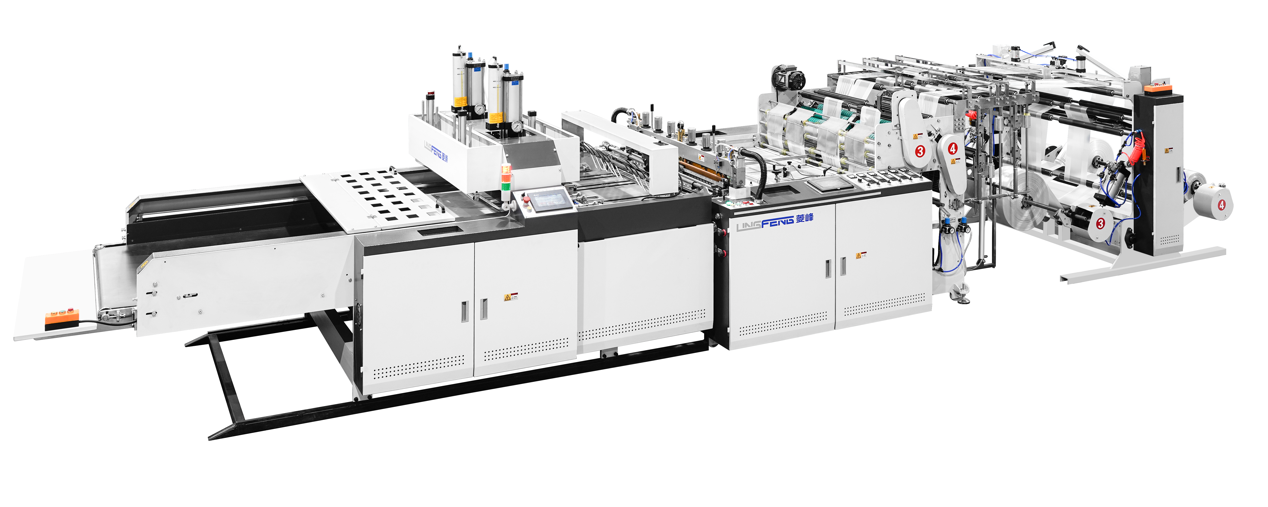
EPC is distinct from tension control, although the two functions are often specified together. Tension control manages the longitudinal force on the film; EPC manages lateral position. A machine can have excellent tension control and still suffer edge drift if the web is not laterally guided. Conversely, EPC cannot compensate for tension instability — if the film is stretching and relaxing, the edge position will oscillate even with perfect lateral correction. The two systems work as a pair. Production descriptions of EPC-equipped T-shirt bag machines note that the integrated EPC and dancing-roller tension control system addresses film deviation, uneven tension, and unstable bag forming together, rather than treating them as separate problems.
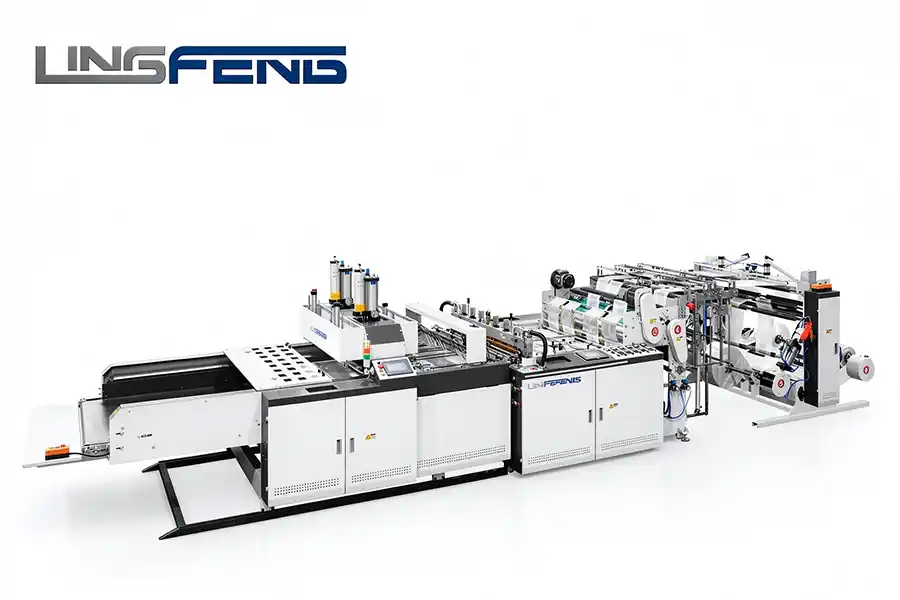
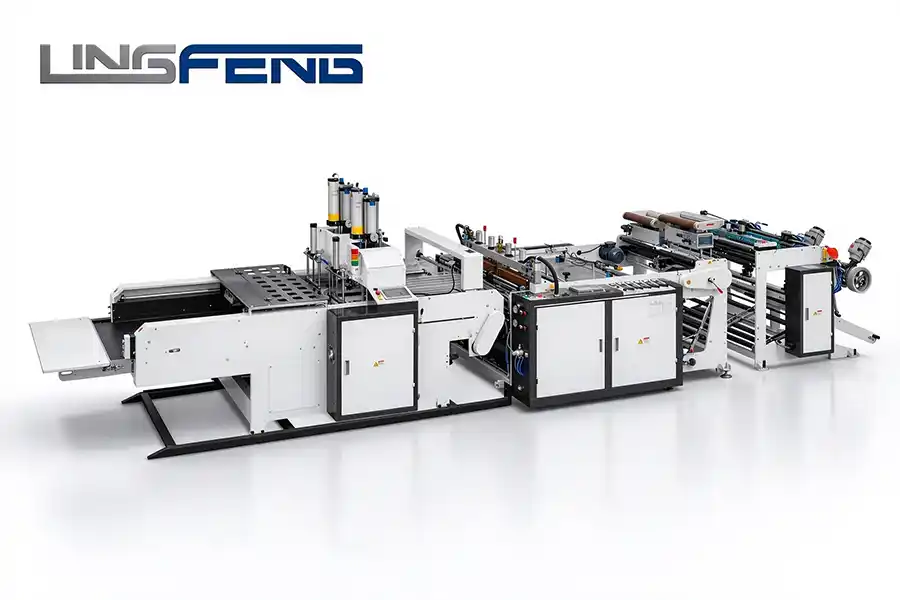
The T-shirt bag machine range includes configurations where EPC is integrated alongside tension control and independent servo drives, which is the architecture that makes the correction effective at production speeds rather than only during slow commissioning runs.
Film does not drift because the machine is poorly built. It drifts because the unwind roll is not perfectly cylindrical, because the film has thickness variation across its width, because the web path has a slight asymmetry, or because the film is being pulled from one side more than the other. These are normal conditions in flexible film processing.
The cost of drift is not always visible as a line item. It appears in several places at once.
Trim waste. If the film edge is not where the cutting station expects it, the trim margin must be set wider to avoid producing an undersized bag. Converting-industry analysis notes that thick or thin edges are often trimmed wider than necessary, “converting saleable web into regrind or waste”. The wider the drift tolerance, the wider the trim allowance, and the more film is lost per roll.
Seal inconsistency. The sealing jaw has a designed contact area. If the film edge moves outside that area, the seal is formed on a different part of the bag, or partially off the bag. The result is a weak seal that may pass a visual check but fail under load.
Print registration error. On printed film, the print-mark sensor and the handle punch are aligned to a fixed lateral reference. If the web drifts, the punch lands off-centre relative to the printed design. The bag is not defective in the structural sense, but it is off-spec in the brand sense.
Speed limitation. Operators reduce line speed when variation is difficult to manage. Converting Quarterly describes this as “capacity that is available but not produced” — the line could run faster, but the operator slows it down to keep the drift within a tolerable band.
Operator intervention. Manual edge correction consumes attention. The operator nudges the unwind, checks the edge, and returns to the sealing station. Each intervention is small, but across a shift they accumulate into lost effective minutes.
The economic mechanism that ties these costs together is what the converting industry calls “material giveaway.” A line that must run above the minimum target to protect against variation is giving away material on every roll that passes specification. Converting Quarterly reports that running 2–3% over target to protect the minimum is common, and that reducing variation with closed-loop control and recovering even 1.0–1.5% of target would return roughly $125,000 to $190,000 per line per year on a representative midsized line. That figure is for a profile-control context, not a bag machine specifically, but the mechanism is the same: lateral variation forces a wider operating margin, and the margin is paid in film.
The decision to specify EPC is not binary across all bag production. It depends on the film, the print, the lane count, and the bag specification.
| Operating Variable | Without EPC | With EPC | What It Means for Output |
|---|---|---|---|
| Film edge position | Drifts within a tolerance band; operator corrects manually | Held at a fixed lateral reference; correction is automatic | Fewer manual adjustments; more effective cycling minutes |
| Trim allowance | Must be sized to cover the drift band | Can be narrowed because edge position is controlled | Less film converted to trim per roll |
| Seal placement on the bag | May shift laterally if the web moves outside the sealing area | Sealing contact area remains consistent relative to the edge | Fewer weak-edge seals; higher first-pass yield |
| Print-mark registration | Print and punch alignment drifts with the web | Print-mark sensor and punch remain aligned to a stable lateral reference | Fewer off-register bags on printed work |
| Multi-lane machines | A single drift can affect multiple lanes simultaneously | Correction is applied before the web is split, containing the disturbance across lanes | Less simultaneous scrap across lanes |
| Operator workload | Continuous edge monitoring and manual correction | Exception-based monitoring | Operator attention released for sealing, changeover and quality checks |
| High-speed running | Drift compounds faster; speed may be reduced to keep it manageable | Correction bandwidth supports stable running at higher cycle rates | Rated speed becomes more achievable in production |
The pattern is consistent: EPC does not increase the machine’s rated speed. It protects the conditions under which the rated speed can be sustained. A machine running without EPC may still hit its rated cycle rate in a short demonstration, but in production the operator’s manual corrections and the wider trim allowance consume the margin that the rated speed assumes.
The comparison also clarifies where EPC matters less. A line running unprinted, thick-film, large-format bags at modest speed with a generous trim allowance may tolerate drift without a meaningful economic penalty. EPC earns its place when the film is thin, printed, running at high cycle rates, or split across multiple lanes.
Before adding EPC to a specification, or before concluding that an existing line needs a retrofit, work through the following sequence. Each step produces a piece of evidence that either supports or weakens the case.
Step 1: Measure the actual drift band.
Run the line for a representative shift and record the lateral position of the film edge at the sealing station at regular intervals. If the edge stays within a band narrower than the trim allowance, EPC is not the binding constraint. If the edge regularly approaches or exceeds the trim margin, the drift is producing waste.
Step 2: Check whether drift correlates with roll changes.
If the edge position shifts after every roll change and then settles, the drift is a roll-alignment problem rather than a continuous control problem. EPC can compensate, but the root cause is the unwind setup. Correct the setup first; EPC then becomes a stabiliser rather than a corrector.
Step 3: Examine the reject stream for lateral defects.
Sort rejected bags by defect type. If the dominant defect is off-centre handle punching, edge-weak seals, or print misregistration, the reject stream is telling you that lateral position is not controlled. If the dominant defect is seal temperature or film thickness related, EPC will not address it.
Step 4: Quantify the trim allowance.
Calculate the difference between the film width consumed and the film width that becomes saleable bag. If the trim allowance is wider than the process capability requires, the excess is a candidate for recovery through EPC.
Step 5: Check the lane count.
On a double-line or multi-line machine, a single lateral drift affects multiple lanes at once. The consequence of drift scales with lane count, which strengthens the case for EPC on multi-lane configurations.
Step 6: Confirm the actuator bandwidth matches the line speed.
EPC correction must be fast enough to track the drift at production speed. A slow actuator will chase the edge and never settle. The machine specification should state the correction response in relation to the maximum cycle rate, not just the presence of an EPC sensor.
This sequence does not produce a yes-or-no answer in every case. It produces a ranked set of constraints: if drift is the dominant lateral loss, EPC addresses it directly. If drift is a symptom of roll misalignment or tension instability, EPC is a partial fix and the upstream cause should be corrected first.
The value of EPC becomes clearer when it is placed in a specific production context rather than discussed as a generic feature.
Scenario A: Printed retail shopping bags on a double-line machine. The bags carry a store logo, and the handle punch must align with the printed design. The film is thin HDPE, which is prone to lateral wander. Without EPC, the print-mark sensor and the punch drift relative to each other, and a proportion of bags are rejected for off-centre handles. With EPC holding the web at a fixed lateral reference before the print-mark station, the punch remains aligned to the print. The reject rate attributable to lateral misalignment falls, and the operator is not manually correcting the unwind between roll changes. This is the configuration where EPC is most clearly justified: printed film, thin gauge, multi-lane, high cycle rate.
Scenario B: Unprinted heavy-duty bags on a single-line machine. The bags are large, the film is thick, the trim allowance is generous, and the line runs at a moderate cycle rate. Drift occurs, but it rarely breaches the trim margin or causes a seal defect. EPC would reduce the operator’s manual corrections, but the economic return is smaller because the losses it prevents are smaller. In this scenario, tension control and roll-alignment discipline matter more than lateral correction.
Scenario C: Biodegradable film on a dedicated line. PLA/PBAT film has a narrower sealing window and is more sensitive to tension variation. Lateral drift interacts with tension instability: the film stretches unevenly, and the edge position oscillates. EPC alone does not solve the problem, but combined with dancing-roller tension control it reduces the coupled variation that produces unstable bag forming. The application resources for biodegradable bag production describe the sealing and tension considerations that make this combination necessary rather than optional on eco-film lines.

Once you have established that lateral drift is a material loss on your line, the next question is not whether EPC is a good feature in isolation, but whether the machine configuration you are considering integrates EPC with the tension and servo architecture that makes it effective. EPC specified as a standalone add-on on a machine with a shared drive and a simple tension dancer will correct edge position, but it will not address the coupled variation that produces unstable bag forming at speed. The more coherent configuration is EPC combined with independent servo feeding and dancing-roller tension control, so that lateral position, longitudinal tension, and cut length are controlled as a system rather than as separate variables.
The lane-count and servo-architecture landscape across the T-shirt bag range is covered in the T-shirt bag machine buying guide , which places EPC within the broader decision sequence of bag specification, film compatibility, and output planning.
How to Choose a Plastic Bag Making Machine: A Complete Buyer's Guide
T-shirt Bag Machine Buying Guide: Single vs Multi-Line Selection
Single Line vs Double Line T-Shirt Bag Machine: Which Configuration Matches Your Production Reality?
How to Calculate T-Shirt Bag Machine Output: From Rated Speed to Real Shift Yield
This article is part of Lingfeng Machinery’s technical content library. No direct sales or pricing information is included. All technical discussions aim to help you make informed purchasing decisions.



 EN
 ES
 AR