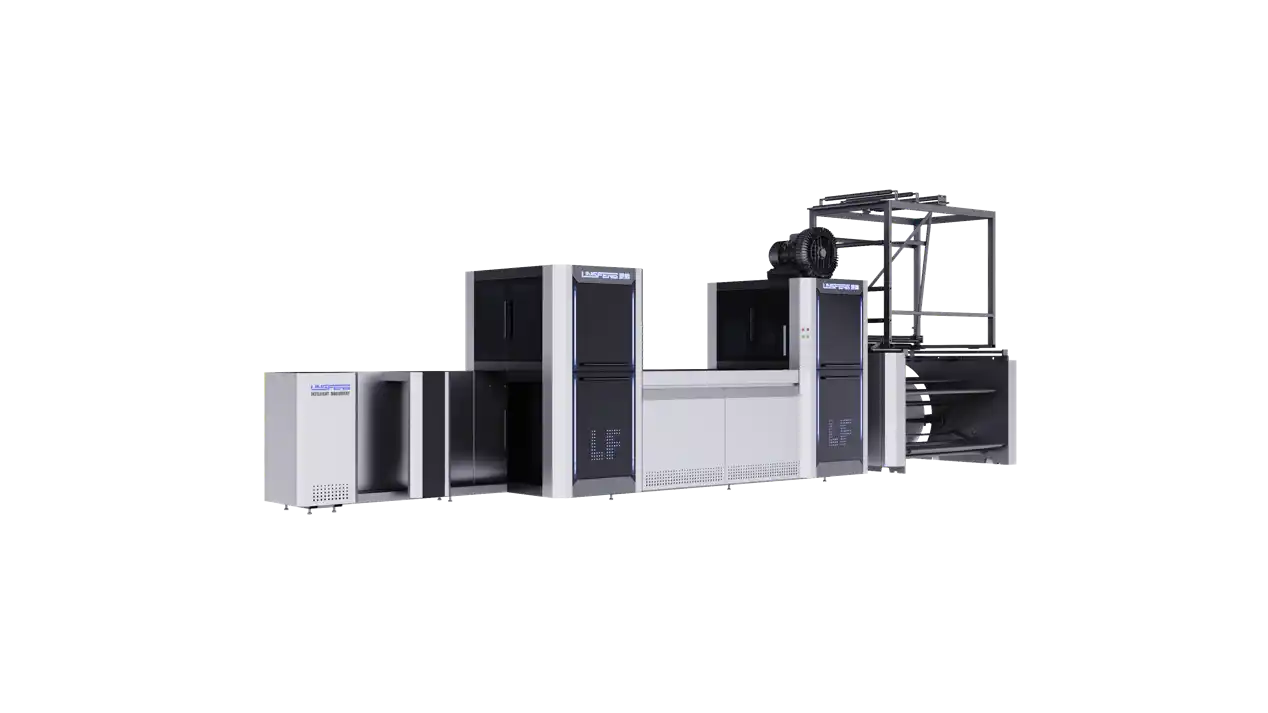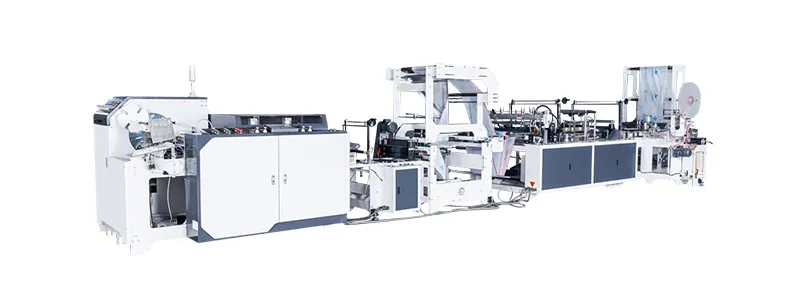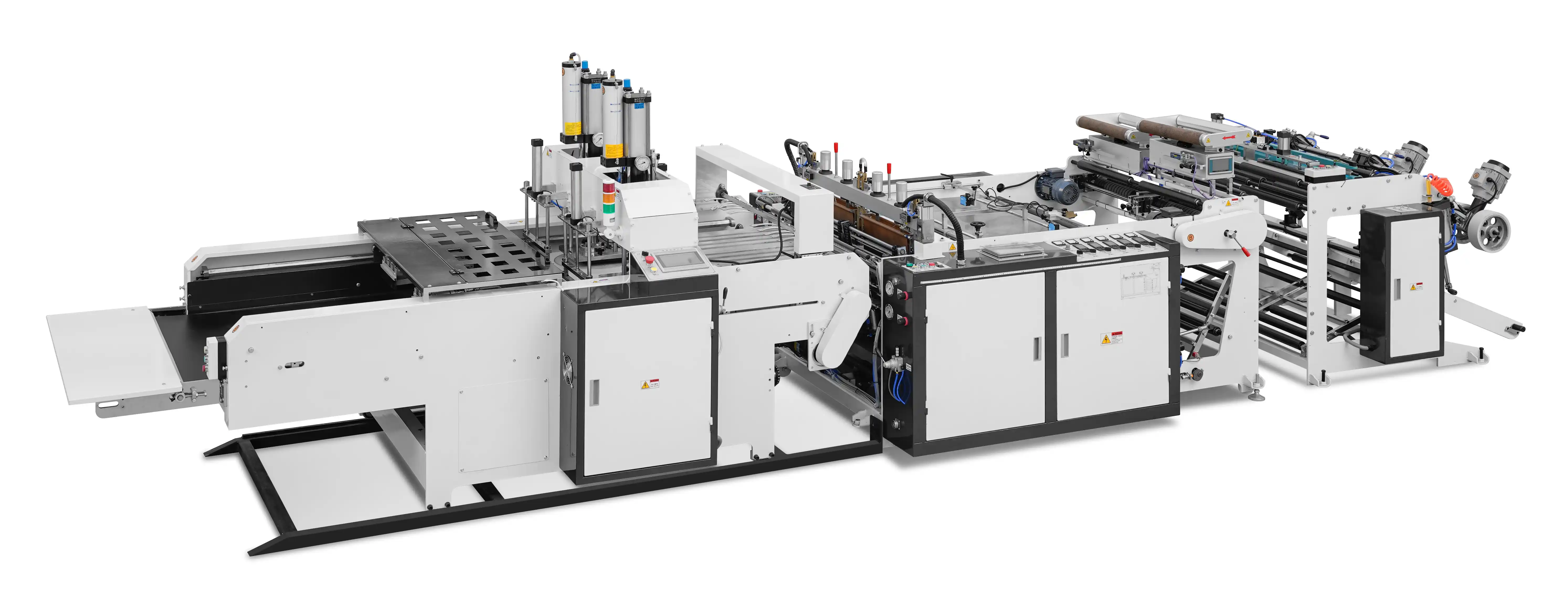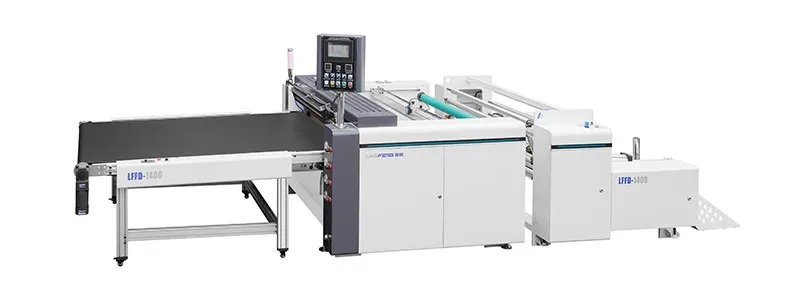

You are comparing T-shirt bag machines, and every supplier gives you a number. 250 bags per minute. 300. Sometimes 350. The numbers are not lies, but they are not production plans either. They describe what the machine can do under controlled conditions — fresh film, no stops, no changeovers, no rejected bags. Your factory will not operate under those conditions. This guide shows how to convert a rated speed into a realistic shift output figure, using the same OEE (Overall Equipment Effectiveness) framework that manufacturing operations use to measure actual equipment performance. The goal is not to distrust the number on the spec sheet. The goal is to know exactly what you are buying.
Every output calculation begins with the machine’s cycle rate and its lane configuration. A single-line T-shirt bag machine produces one bag per cycle. A double-line machine produces two bags per cycle. The nominal hourly output formula is:
Q_rated = C × n × 60
Where C is the machine cycle rate in cycles per minute, n is the number of bags produced per cycle, and 60 converts minutes to hours.
A single-line machine cycling at 80 times per minute has a nominal output of 80 × 1 × 60 = 4,800 bags per hour. A double-line machine at the same cycle rate produces 80 × 2 × 60 = 9,600 bags per hour. The double-line advantage is visible immediately, but so is a critical caveat: this formula assumes the machine cycles continuously for a full hour. It does not.
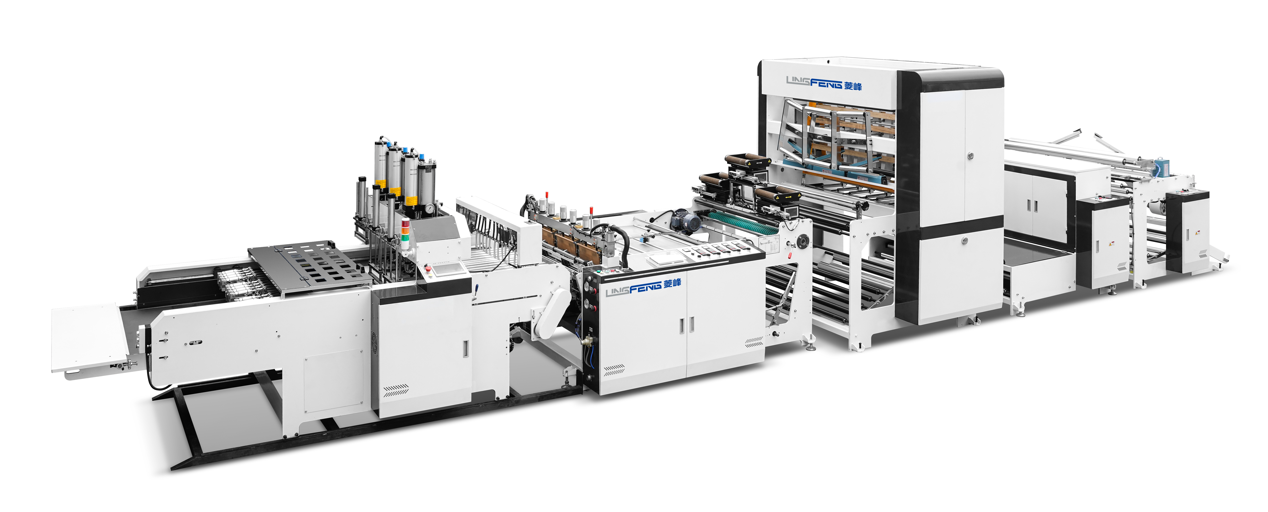
The T-shirt bag machine category page lists the rated speeds and lane configurations across the GDFR range, giving you the input values for this formula. But the rated speed is only the numerator. The denominator — the efficiency factor — is where the real planning work begins.
The gap between nominal output and saleable output is not a bag-making industry secret. It is a measurable, standardised phenomenon. The International Organization for Standardization, through ISO 22400-2 on key performance indicators for manufacturing operations, defines Overall Equipment Effectiveness (OEE) as the product of three factors: Availability × Performance × Quality. In practical terms:
Availability measures uptime: (Planned Production Time − Downtime) ÷ Planned Production Time.
Performance measures speed: (Actual Run Speed ÷ Theoretical Speed) × 100%.
Quality measures yield: (Good Bags ÷ Total Bags) × 100%.
For a well-run bag making operation, OEE typically falls in the 80–90% range. A machine rated at 250 bags per minute will produce an average of 200–225 good bags per minute over a shift once availability, speed, and quality losses are accounted for. For a newly commissioned line or a factory still stabilising its process, OEE can sit closer to 60–70%. That is not a machine defect. It is the normal distance between a nameplate number and an operating reality.
The practical implication is straightforward: if you plan capacity using the rated speed, you will overestimate your shift output by 15–40%. That overestimate propagates directly into your delivery commitments, your raw material purchasing, and your labour planning.
OEE is useful as a framework, but it is abstract. To estimate your actual output, you need to quantify the specific losses that occur in a T-shirt bag operation. The six major loss categories are well established in manufacturing engineering, and each has a direct counterpart in bag making.
| Loss Category | What It Looks Like in a T-Shirt Bag Line | Typical Magnitude |
|---|---|---|
| Breakdowns | Unplanned stops from sealing jaw faults, servo alarms, film jams | 2–8% of planned time |
| Setup and changeover | Bag size change, film type switch, sealing temperature re-stabilisation | 10–30 minutes per event; 5–10% of shift if two changes occur |
| Idle and minor stops | Film roll changes, registration adjustments, brief operator interventions | 2–5 minutes per roll change; 1–3% of shift |
| Reduced speed | Running below rated speed to accommodate thicker film, biodegradable film, or print registration tolerance | 10–20% speed loss on difficult materials |
| Quality defects | Seal leaks, mis-cuts, handle punch misalignment, print registration errors | 1–3% reject rate for stable production |
| Startup and rework | Scrap generated while seals heat up and registration settles after a stop | 1–2% of shift output |
The changeover loss deserves particular attention because it is the one most often omitted from capacity plans. A typical bag size change on a T-shirt bag machine can take 10–30 minutes. If your production schedule includes two size changes per shift, that is 20–60 minutes of lost cycling time — before accounting for the scrap generated while the new seals stabilise. For a single-line machine running an 8-hour shift, losing 40 minutes to changeover is a 8.3% reduction in available production time. The rated speed number does not reflect that loss.
The film roll change loss is smaller but continuous. A manual roll change takes 2–5 minutes. If a roll lasts two hours on a machine running at 250 bags per minute, the changeover is roughly 1.7% of operating time. Automatic splicers reduce this to near zero, but they add capital cost and maintenance complexity. For producers running smaller rolls or longer bags — which consume film faster — the roll-change frequency rises, and the loss compounds.
The rated speed on a T-shirt bag machine is almost always published for HDPE or LDPE. Those films have a relatively wide heat-sealing window and forgiving mechanical behaviour. The same machine running biodegradable PLA/PBAT film operates under different physical constraints.
Biodegradable films require lower sealing temperatures, tighter temperature control, and longer dwell times to achieve adequate seal strength without burning. The sealing temperature range for PLA is typically 110–140°C, while PBAT requires 130–160°C, with dwell times of 0.3–0.8 seconds. Because the processing window is narrower, production speed is generally lower — around 80–150 bags per minute for biodegradable film, compared with the 250–300 bags per minute range common for PE on the same class of machine. The speed limitation is not primarily a servo or mechanical constraint. It is a sealing-time constraint: the film needs more time in the sealing jaw to form a reliable bond, and that dwell time sets the ceiling on cycles per minute.
This matters for output calculation because the Performance term in OEE is not a fixed percentage. It is material-dependent. A machine that achieves 85% of rated speed on HDPE may achieve 65–75% of its PE-rated speed on PLA/PBAT, even when it is correctly configured for biodegradable film. If you are planning a biodegradable production line, the rated speed you should use in the formula is the biodegradable-specific speed envelope, not the PE-rated headline number.
The application resources for biodegradable bag production outline the sealing and tension considerations that define this speed envelope. A machine configured for biodegradable film — with appropriate temperature control, anti-stick sealing surfaces, and dwell-time capability — will land at the upper end of the 80–150 bags per minute range. A general-purpose machine that has not been adapted for biodegradable film will land at the lower end, or below it.

The following sequence converts a rated speed into a planning figure that reflects your actual operating conditions. It is adapted from the measurement logic used in production engineering and from the step-by-step efficiency framework published in Lingfeng’s output estimation guide.
Step 1: Establish the nominal hourly output.
Use Q_rated = C × n × 60. For a double-line machine rated at 300 bags per minute, the nominal output is 300 × 60 = 18,000 bags per hour. (The bags-per-cycle factor is already embedded in the bags-per-minute rating; if the rating is expressed in cycles per minute, multiply by the number of lanes.)
Step 2: Define your planned production time.
An 8-hour shift is 480 minutes. Subtract scheduled breaks, cleaning, and planned maintenance. A realistic planned production time for an 8-hour shift is often 440–460 minutes.
Step 3: Quantify availability losses.
Subtract unplanned downtime and changeover time from planned production time. If you expect two changeovers at 20 minutes each and 15 minutes of unplanned stops, availability time is 460 − 55 = 405 minutes. Availability is 405 ÷ 460 = 88%.
Step 4: Apply the performance factor.
Performance reflects the machine’s actual running speed relative to its rated speed. For stable HDPE production, 80–90% is a reasonable assumption. For biodegradable film, use the biodegradable speed envelope as the reference, not the PE rated speed. If the machine is rated at 300 bags/min on PE but runs biodegradable film at 120 bags/min, the performance factor against the PE rating is 40%, but the machine may be running at 90–95% of its biodegradable-rated capability.
Step 5: Apply the quality factor.
For stable production, a reject rate of 1–3% is typical. A 2% reject rate gives a quality factor of 98%.
Step 6: Multiply to get effective OEE and shift output.
OEE = Availability × Performance × Quality. Shift output = Nominal hourly output × OEE × Scheduled hours.
A worked example makes the arithmetic concrete. A double-line machine nominally rated at 300 bags/min, running HDPE with 88% availability, 85% performance, and 98% quality, yields an OEE of 88% × 85% × 98% = 73.3%. Over an 8-hour shift with 460 planned minutes, the saleable output is approximately 300 × 460 × 0.733 ≈ 101,000 bags. The nominal figure for the same period would be 300 × 480 = 144,000 bags. The gap — roughly 43,000 bags — is the difference between a spec sheet and a production plan.
The OEE framework is only useful if it changes a decision. Two scenarios illustrate how the same formula leads to different conclusions depending on the production context.
Scenario A: A converter running standard HDPE shopping bags on a double-line machine. This producer has a stable order book, changes bag size once per week, and runs consistent film quality. The changeover loss is small because it occurs infrequently. The performance factor is high because HDPE behaves predictably. The availability factor is high because the machine is well maintained and the operators are experienced. The resulting OEE may land in the 78–85% range. For this producer, the double-line machine’s output advantage is real and capturable, because the losses that erode the advantage are controlled.
Scenario B: A converter adding biodegradable bags on a general-purpose double-line machine. This producer has not yet stabilised biodegradable film processing. The film’s narrow sealing window forces speed reductions. Reject rates are higher during startup and after changeovers because the sealing parameters take longer to stabilise. Changeovers between PE and PLA/PBAT require thorough cleaning to avoid cross-contamination. The OEE may sit in the 60–70% range. The machine’s rated speed is unchanged, but the output that reaches the warehouse is meaningfully lower. For this producer, the biodegradable production plan should be built on the biodegradable speed envelope and a lower OEE assumption, or the machine should be configured with biodegradable-specific sealing hardware from the outset.
Once you have a realistic OEE range for your production context, the next step is to verify that the machine configuration you are considering can actually deliver the rated speed you intend to use as the numerator. A machine’s rated speed is valid only within a defined window of bag length, film thickness, and material grade. Before finalising a capacity plan, confirm three things with the supplier: the speed definition (cycles per minute, bags per minute, or bags per hour), the product definition used for the quoted run (bag dimensions, film thickness, material grade), and whether the quoted speed assumes continuous cycling or includes realistic stops. The GDFR model pages list rated speeds, bag width and length ranges, and material compatibility, providing the input values for a precise calculation. You can review the full lane-count and film-compatibility landscape in the T-shirt bag machine buying guide before narrowing to a specific configuration.
This article is part of Lingfeng Machinery’s technical content library. No direct sales or pricing information is included. All technical discussions aim to help you make informed purchasing decisions.




 EN
 ES
 AR