EN
EN
 ES
ES
 AR
AR


Article Overview: Estimating T-shirt bag machine output per hour starts with a cycle-time formula and then subtracts efficiency losses such as reel changes, startup, rejects, and operator stops. This article is written for engineering, operations, and procurement teams that need a planning baseline before comparing machines. Worked examples are labelled as hypothetical and do not replace a supplier's witnessed production test.
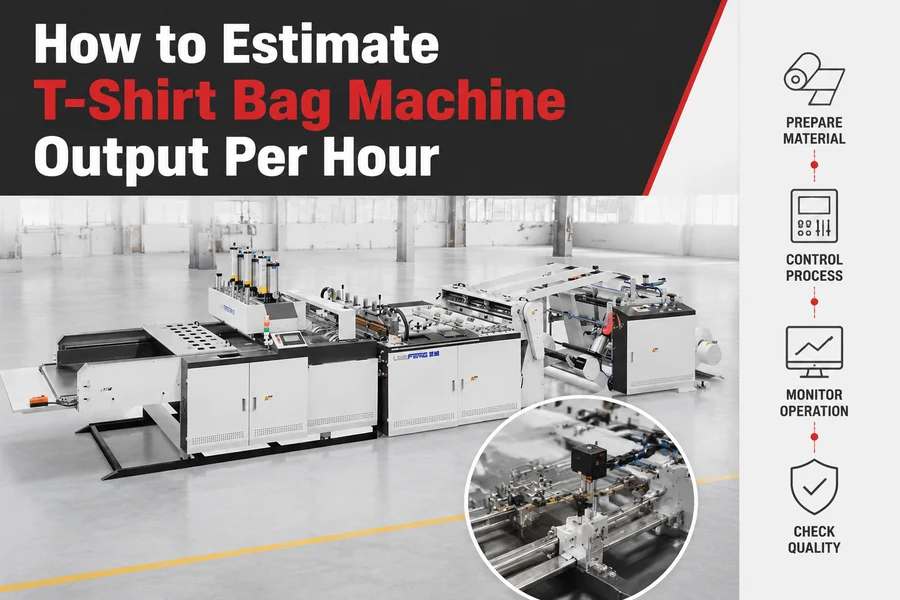
What Is the Formula for Calculating T-shirt Bag Machine Output Per Hour?
The formula is hourly nominal output equals cycles per minute times bags per cycle times 60. It assumes the machine cycles continuously, so the result is a rated baseline before efficiency losses are subtracted.
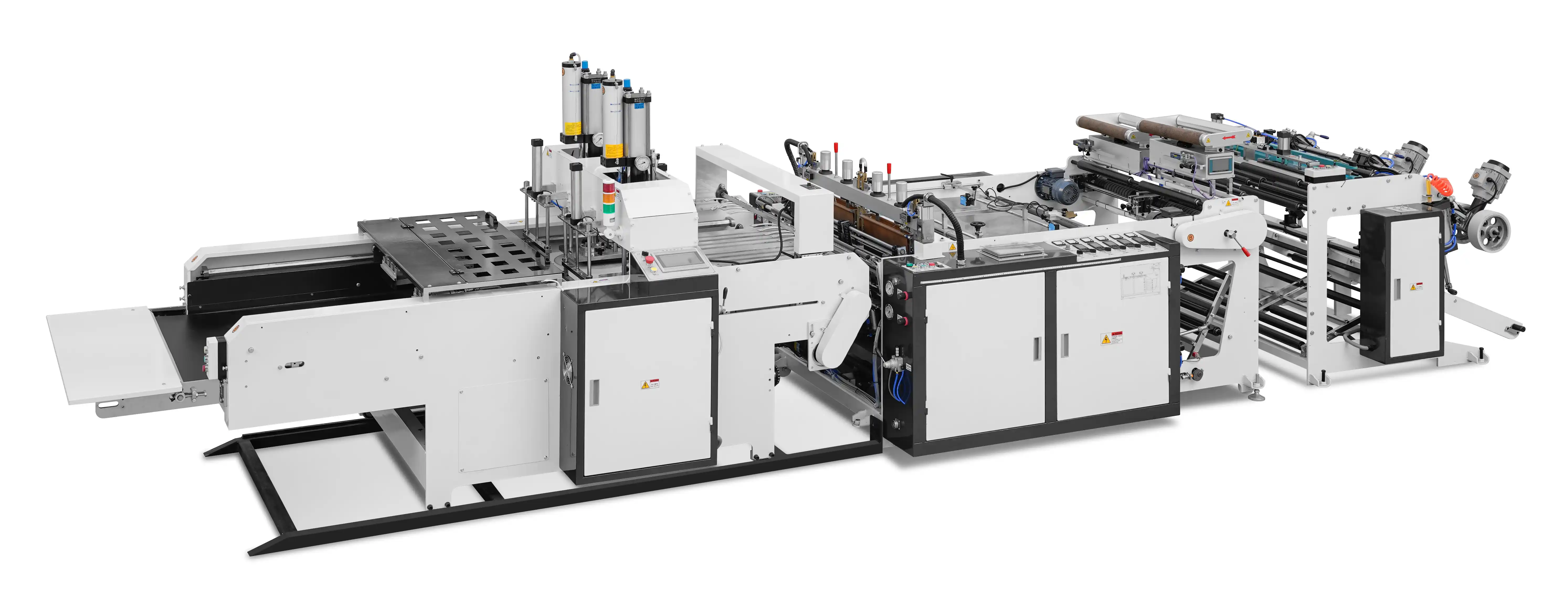
T-shirt bag machines make one bag each time the film indexing, sealing bar, and cutting knife complete a cycle. The useful machine rate is cycles per minute, because every cycle can contribute one or more bags depending on the lane configuration. A single-line machine forms one bag per cycle in most T-shirt bag layouts. A double-line machine forms two bags per cycle, which doubles the bags-per-minute value even when the mechanical cycling rate is unchanged.
The planning equation is:
Q_rated = C x n x 60
- Q_rated
- Nominal output in bags per hour.
- C
- Machine cycle rate in cycles per minute.
- n
- Number of bags produced per cycle.
- 60
- Conversion factor from minutes to hours.
For example, a single-line machine cycling at 80 times per minute has a nominal output of 80 x 1 x 60 = 4,800 bags per hour. A double-line machine with two bags per cycle at the same cycle rate has a nominal output of 80 x 2 x 60 = 9,600 bags per hour. Published comparison material for T-shirt bag equipment lists single-line speeds up to 120 bags per minute and double-line speeds of 200 to 300 bags per minute. Those numbers are nominal rates, not guaranteed shift output.
Ask for the speed basis before doing any conversion. A quote can be stated in cycles per minute, bags per minute, or bags per hour; in a multi-lane machine, bags per minute equals cycles per minute multiplied by the number of lanes.
Why Is Actual Output Lower Than Rated Speed on a Bag Making Machine?
Actual output is lower than rated speed because scheduled time includes reel changes, startup, sealing dwell, rejects, and operator stops. Convert those losses into an efficiency factor and multiply nominal output by it.
While the machine is not cycling acceptable bags, no output accumulates. Reel changes occur whenever a film roll runs out. Startup and changeover create scrap while seals heat up and registration is adjusted. Rejected bags consume film and cycling time without becoming saleable output. Each of these losses separates the rated speed from the output you can plan around.
Step 1: Define the measurement period
Decide whether the target is one hour, an 8-hour shift, or 24 hours. Exclude planned breaks, cleaning, and maintenance windows from scheduled time.
Step 2: Record non-cycling events
Count film roll changes, line setup, startup ramp, operator adjustments, and waiting time. A shorter film roll that is consumed quickly increases the number of stops.
Step 3: Track rejected bags
Subtract bags lost to seals, cuts, print alignment, or startup scrap. Rejects reduce saleable output even while the machine is cycling.
Step 4: Build an efficiency factor
Divide acceptable bags produced by the number that would result from continuous cycling at rated speed. Express the result as a decimal, such as 0.75, and apply it to the nominal formula.
As a labelled example, if an 80 cycle/min single-line machine feeds film for only 45 minutes during one hour and 3 percent of cycles are rejected, saleable output is 80 x 1 x 45 x 0.97 = 3,492 bags for that hour. That is about 73 percent of the nominal 4,800-bag figure. The same calculation logic applies to any line; only the input values change.
How Does Bag Length Change the Output Rate of a T-shirt Bag Making Machine?
Bag length only changes the mechanical cycle rate when film indexing time becomes a limiting step. Longer bags use more film per cycle, so roll changes and start-stop losses happen more often and realized output falls.
At a constant cycling speed, a longer bag requires a longer indexing stroke before the sealing and cutting station can fire. If that stroke takes more time than the cycle leaves available, the machine cannot hold its rated cycles per minute. Most speed ratings are therefore valid only for a specified range of bag lengths and film gauges.
Beyond the mechanical limit, bag length changes material consumption. The average film used per hour is:
Q_material = Q_rated x L
Here Q_material is film consumed per hour in meters and L is the average film consumed per bag in meters, including handle cutout and trim allowances. For a nominal output of 4,800 bags per hour, a 0.50 m consumption per bag gives 2,400 m of film per hour. At 0.65 m per bag, the same nominal output consumes 3,120 m per hour. The higher consumption shortens the interval between reel changes and adds more start-stop events over a shift.
The practical effect is indirect but important: a short bag lets each reel last longer, while a long bag increases interruption frequency and waste. When you compare output claims, ask which bag length was used for the quoted cycling speed.
How Many T-shirt Bags Can a Single-line Machine Produce in One Shift?
Estimate shift output as cycles per minute times bags per cycle times scheduled hours times efficiency times 60. A hypothetical single-line machine at 80 cycles/min with 75 percent efficiency over 8 hours yields about 28,800 saleable bags per shift.
The shift-level equation is:
Q_shift = C x n x H x η x 60
Where C is cycles per minute, n is bags per cycle, H is scheduled shift hours, η is the decimal efficiency factor, and 60 is minutes per hour. For a single-line machine, n is normally 1.
Using the hypothetical values above:
Q_shift = 80 x 1 x 8 x 0.75 x 60 = 28,800 bags
If the same machine ran every minute at rated speed, the nominal shift figure would be 80 x 8 x 60 = 38,400 bags. The 9,600-bag gap represents reel changes, setup, startup scrap, rejects, and other stops. That gap is why an efficiency discussion should happen before a capacity plan is locked.
If this estimate is part of a purchasing decision, compare your required output with the configuration differences in the single-line vs double-line T-shirt bag machine comparison. The choice changes the n term in the formula and also changes changeover complexity and operator attention.
Verifying Quoted Output Before You Commit to a Number
Use output estimates for comparison, but treat every quoted speed as an upper bound until the supplier states the operating conditions behind it. A rate without a speed definition, bag size, film specification, and efficiency basis is not yet a production plan.
- Speed definition: Is the number cycles per minute, bags per minute, or bags per hour?
- Product definition: Which bag length, width, film thickness, and material grade were used for the quoted run?
- Operating basis: Does the supplier assume continuous cycling or realistic stops for reel changes and setup?
- Validation evidence: Can the supplier show a trial report, a full-reel run video, or an installation reference with similar film and bag dimensions?
Before comparing vendor quotes, use a structured checklist. Check the T-shirt bag machine procurement questions for quoted speed so every supplier states the same operating basis. This keeps your comparison focused on planning reality rather than marketing speed.
If the product mix includes bag styles outside the T-shirt format, the sealing family itself can change attainable output. Refer to the bottom sealing versus side sealing bag machine guide when those film-path differences matter to your line decision.
FAQ
Can nominal bags per minute be converted directly into an hourly production plan?
Only after efficiency losses are removed. Multiplying 120 bags per minute by 60 gives 7,200 nominal bags per hour, but reel changes, startup, sealing dwell, and waste make that an upper bound. Use a measured or negotiated efficiency factor to estimate saleable output.
If a double-line machine is rated in bags per minute, should I still use cycles per minute?
Yes. Bags per minute equals cycles per minute times the number of lanes forming bags. If the supplier quotes bags per minute and you insert that number into the formula with n equal to 1, you will undercount a two-lane machine. Always confirm which rate is being quoted.
Should the efficiency factor change when bag length changes?
Usually it should. Longer bags consume film faster, so reel changes happen more often and start-stop waste increases. Recalculate or adjust the factor for each product size rather than applying one number to every bag length in your order mix.
Conclusion: Turn a Speed Rating into a Realistic Output Estimate
Reliable T-shirt bag machine output per hour starts from the cycle-time formula and then subtracts real operating losses such as reel changes, startup, sealing dwell, rejects, and operator stops. Bag length affects film consumption and interruption frequency, but the same estimation process works for single-line and double-line machines. Use the formula and verification questions to compare quotes on an equal basis, and treat every nominal speed as an upper bound until it has been demonstrated under your operating conditions.