
You are planning to produce T-shirt bags — the ubiquitous vest-handle carriers used in supermarkets, grocery stores, and retail checkout counters worldwide. You know the bag type. You know the market. But when you start comparing machines, the options multiply: single-line, double-line, three-line, four-line, with or without EPC, with or without inline side gusset, running HDPE, LDPE, or biodegradable film. Each configuration promises higher output, better precision, or greater flexibility. How do you decide which one actually fits your production reality?
This guide is not a product catalog. It is a decision framework. It walks you through every technical dimension that matters — from bag structure and lane-count economics to film compatibility, edge control, gusset functions, handle punching precision, and real output calculation. By the end, you will know which questions to ask, which parameters to prioritize, and how to match a machine configuration to your specific bag specification and production target.
For a broader overview of how T-shirt bag machines fit into the complete plastic bag making machine landscape, the general selection guide on plastic bag machine types covers the full decision sequence from bag type through supplier vetting. This article drills deeper into the T-shirt bag category specifically.
Before comparing machines, you need to understand the product. A T-shirt bag is not a simple flat pouch. It is a complex assembly of seals, cuts, and folds that must work together to hold weight, open easily, and carry comfortably.
A typical T-shirt bag consists of:
Tubular film body: The bag is formed from a tube of film, either blown or cast. The tube provides the side walls.
Bottom seal: A heat seal closes the bottom of the bag. This seal must be strong enough to carry the loaded weight without leaking or tearing.
Handle cutout: A die-cut or punched hole in the top section creates the vest handle. The shape and size of this cutout determine how comfortably the bag can be carried.
Top edge: The top edge is often folded or hemmed to reinforce the handle area.
Optional gusset: A side gusset expands the bag’s capacity, allowing it to hold more volume without increasing the flat width.
Optional printing: Many T-shirt bags carry brand logos or store names, requiring print-mark tracking on the machine.
The machine must perform several operations in sequence: unwind the film, maintain tension, seal the bottom, punch the handle, cut the bag to length, and stack or collect the finished product. Each operation has its own precision requirements. The combination of these operations determines the machine’s complexity, speed, and cost.
The application resources for T-shirt bag production describe how these structural elements map to different end-use scenarios, from supermarket checkout to promotional retail.

The most consequential decision you will make is lane count. A “lane” is a parallel production path. A single-line machine processes one bag per cycle. A double-line machine processes two bags per cycle, triple-line three, and four-line four. The choice is not simply about speed. It is about matching production volume to floor space, operator skill, and order stability.
| Selection Dimension | Single-Line | Double-Line | Triple-Line | Four-Line |
|---|---|---|---|---|
| Typical bag types | Large, long, thick bags | General shopping bags | Small-to-medium bags, high volume | Small bags, multi-lane production |
| Machine complexity | Lower | Medium | Higher | Higher |
| Primary advantage | Size flexibility | Balanced output and flexibility | High efficiency | Maximum output per cycle |
| Key confirmation | Bag width, length | Target output | Bag consistency | Bag size range |
| Floor space per bag | Higher | Moderate | Lower | Lowest |
| Changeover complexity | Simplest | Moderate | More complex | Most complex |
| Operator skill required | Basic | Intermediate | Advanced | Advanced |
Single-line machines are the most versatile. They handle the widest range of bag widths and lengths, including large-format bags that exceed the capacity of multi-line machines. If your product mix includes oversized vest bags, heavy-duty thicknesses, or frequent size changes, a single-line machine often delivers the best long-term value. The trade-off is lower output per hour.
Double-line machines are the industry workhorse. They produce two bags per cycle, roughly doubling output without doubling floor space. For stable, high-volume production of standard shopping bags, a double-line configuration usually offers the best balance of throughput, flexibility, and investment. The added complexity is manageable for most established packaging manufacturers.
Triple-line and four-line machines push output even higher, but they demand consistent bag specifications and a stable order book. If you run the same bag size for weeks at a time, a multi-line machine can dramatically reduce labor cost per bag. If you change sizes frequently, the setup time and synchronization complexity may erode the advantage.
The T-shirt bag machine category page lists models across all lane counts, with specifications you can compare side by side.
Once you have chosen a lane count, the next constraint is bag dimensions. Every machine has a maximum bag width and a maximum producing length. Exceeding these limits is not possible without changing machines.
Bag width is determined by the film tube width and the machine’s sealing and cutting width. For multi-line machines, the bag width per lane is smaller because the total film width is divided among lanes. For example, a double-line machine with a maximum film width of 800mm might produce two bags of up to 380mm each. A single-line machine with the same film width could produce one bag up to 700mm wide.
Bag length is controlled by the cutting length. Most T-shirt bag machines produce lengths from 300mm to 700mm. Some single-line models extend to 950mm for large-format bags. If your target market requires extra-long bags — for example, for bulk produce or industrial packaging — you need a single-line machine with extended length capability.
Gusset depth adds another dimension. If your bags need side gussets, the machine must be equipped with a gusset-forming unit. This unit folds the film inward before sealing, creating expandable sides. Gusseted bags are common for shopping bags that need to hold boxed or bulky items.
Film thickness also affects sizing. Thicker films require more sealing dwell time and higher pressure, which can reduce maximum speed. Machines are typically rated for a thickness range, such as 0.010mm to 0.040mm. Confirm that your target thickness falls within the machine’s capability.
For large-width, long, and thick bags, the single-line T-shirt bag machine with inline side gusset illustrates how a single-lane configuration can handle demanding dimensions that multi-line machines cannot match.
The film you run determines sealing temperature, tension settings, and machine hardware. Not all machines are equally compatible with all films. Understanding the differences prevents costly mistakes.
HDPE (High-Density Polyethylene) is stiff, strong, and provides a good moisture barrier. It is the most common material for T-shirt bags because it offers an excellent balance of strength and cost. HDPE requires higher sealing temperatures and robust sealing bars. It also tends to be noisier during unwinding.
LDPE (Low-Density Polyethylene) is softer and more flexible than HDPE. It produces a quieter, more pliable bag. LDPE is often blended with HDPE to improve handle softness and bag feel. Sealing temperatures are lower than HDPE, but tension control becomes more critical because LDPE stretches more easily.
PLA (Polylactic Acid) and PBAT (Polybutylene Adipate Terephthalate) are biodegradable polyesters used for compostable bags. These films are sensitive to heat and moisture. They can stick to sealing blades, stretch under tension, and exhibit inconsistent sealing strength if temperature and dwell time are not precisely controlled. Research published in ACS Omega (American Chemical Society) indicates that PLA/PBAT blends often suffer from poor miscibility, which can lead to variable film properties. For machine selection, this means you need a machine with low-temperature sealing capability, anti-stick blade coating, and precise tension control.
Recycled films introduce variability in thickness, color, and melt index. Machines running recycled content need robust tension control and easy-to-clean sealing components.
The material compatibility section on the T-shirt bag category page lists HDPE, LDPE, OPP/BOPP, and biodegradable PLA/PBAT as supported substrates, with application examples for each. For biodegradable bag production specifically, the application resources for eco-material bag production outline the sealing and tension considerations that differ from conventional PE processing.
EPC stands for Edge Position Control. It is an automatic guidance system that keeps the film web aligned as it travels through the machine. Without EPC, the film can drift left or right, causing misaligned seals, uneven handle punching, and excessive trim waste.
EPC works by using sensors to detect the film edge. When the edge moves, the sensor sends a signal to a controller, which adjusts the unwind stand or a guide roller to bring the film back into alignment. The correction is continuous and automatic.
Why does EPC matter for T-shirt bag production?
Print registration: If your bags are printed, EPC ensures that the print mark aligns with the sealing and cutting positions. Without EPC, printed bags may be cut off-center or the handle may punch through the artwork.
Material savings: A wandering web requires wider trim margins. EPC reduces trim waste by keeping the web centered, which translates directly into lower material cost per bag.
Seal consistency: Misaligned film can cause partial seals or weak seals at the bag edges. EPC keeps the sealing area uniform across the web width.
Higher speed stability: At high cycling rates, even small misalignments compound quickly. EPC allows the machine to run faster without constant operator intervention.
EPC is particularly important for multi-line machines, where a single misalignment can affect multiple lanes simultaneously. It is also essential for thin films and biodegradable films, which are more prone to wander due to their lower stiffness.
The high-speed double-line T-shirt bag machine with EPC demonstrates how EPC integrates with twin independent servo drives to maintain alignment on both lanes at speeds up to 300 pcs/min.
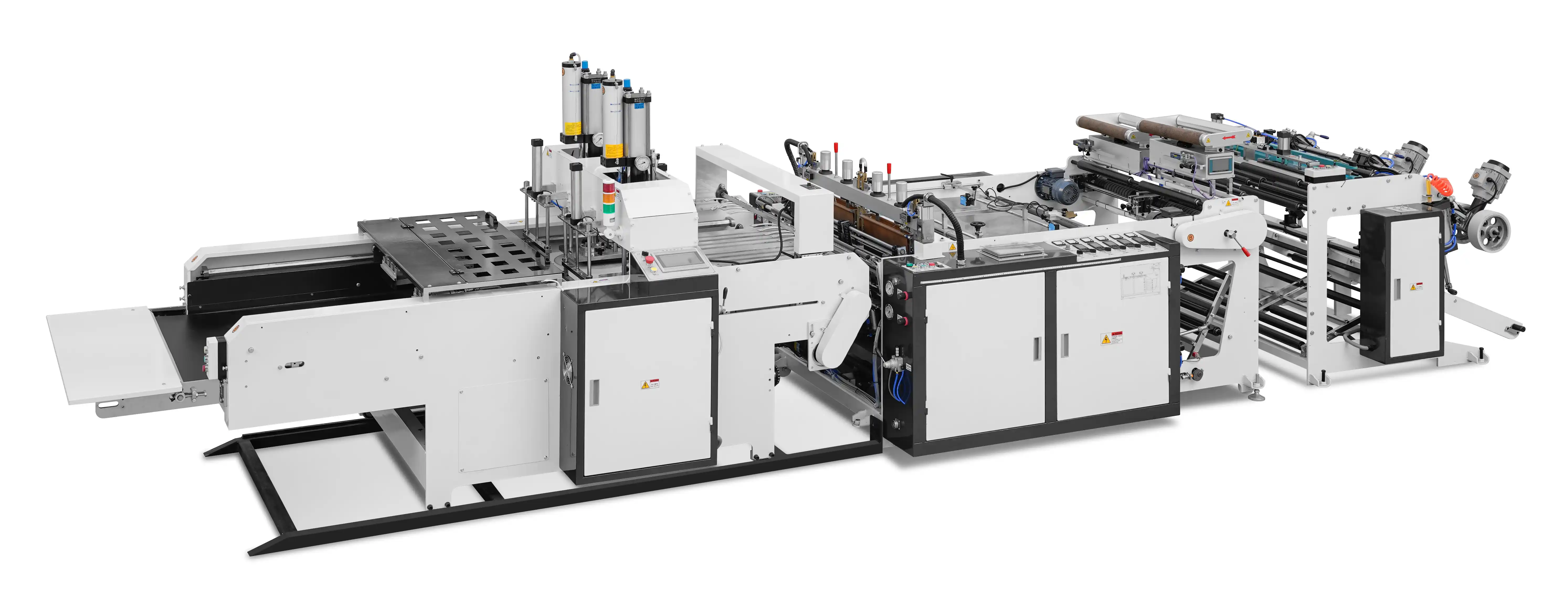
A gusset is a fold in the side of the bag that allows it to expand. T-shirt bags with side gussets can hold more volume than flat bags of the same width. Gussets are common in shopping bags, where the bag must accommodate boxed goods, bulk items, or irregular shapes.
The machine creates a gusset by folding the film inward before sealing. This requires a dedicated gusset-forming unit, often called a “side gusset device” or “inline side gusset.” The unit consists of folding boards, guides, and sometimes a pre-sealing element to hold the fold in place.
Key considerations for gusset-equipped machines:
Gusset depth: The machine must be specified for the maximum gusset depth you need. Common depths range from 50mm to 150mm per side.
Film stiffness: HDPE holds a gusset fold better than LDPE. Very thin or soft films may require additional tension control to keep the gusset crisp.
Speed impact: Adding a gusset unit can reduce maximum speed slightly because of the additional film handling.
Changeover: Switching between gusseted and flat bags requires removing or disengaging the gusset unit. Machines with quick-change gusset modules reduce downtime.
For high-output production of gusseted vest-handle bags, the double-line plastic carry bag machine with hot slitting and side gusset shows how inline hot slitting and side gusseting can be combined in a single pass.
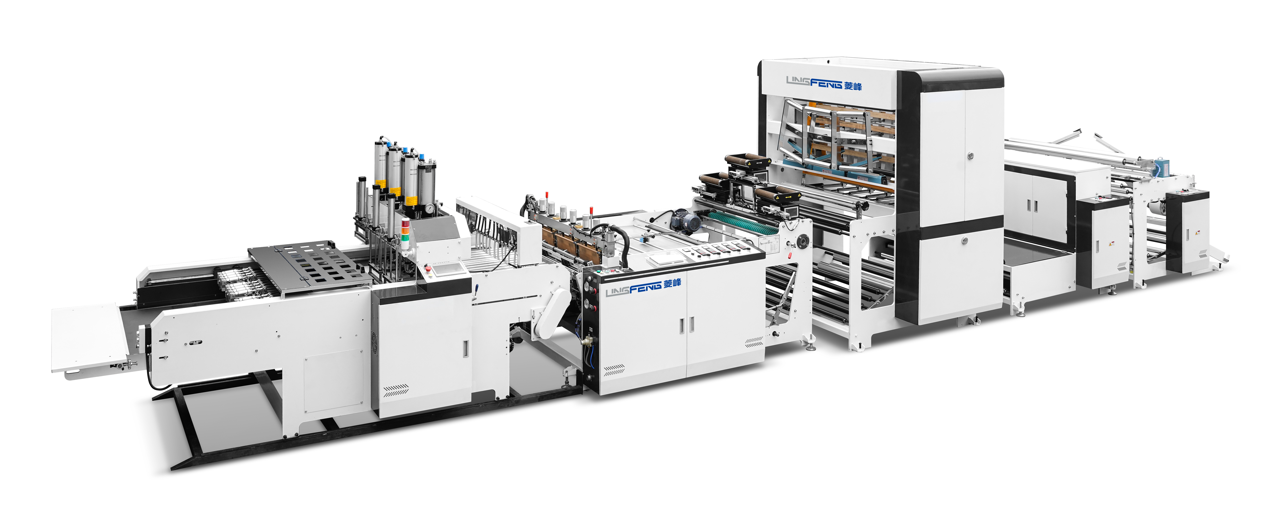
The handle cutout is the defining feature of a T-shirt bag. Its shape, position, and edge quality directly affect how the bag feels to the end user. A poorly punched handle can tear under load, feel uncomfortable, or look unprofessional.
Handle punching is performed by a die or a hot punch. Cold punching uses a sharp die to cut the film. Hot punching uses a heated die to simultaneously cut and seal the edge of the handle hole, preventing tearing. Hot punching is preferred for HDPE and thicker films.
Cutting precision is equally important. The bag length must be consistent from bag to bag. If the cut length varies, the bag stack will be uneven, and downstream packaging or counting may be affected. Modern machines use servo-driven cutting to achieve ±1mm accuracy.
The T-shirt bag category page lists “High-Speed Servo Operation – Produces 250–300 bags/minute with ±1mm accuracy” as a key machine feature. This precision level ensures that each bag matches the specified dimensions, reducing waste and improving customer satisfaction.
For handle punching, the machine must also handle waste removal. Punched holes create small pieces of film waste. Machines with automatic waste collection keep the production area clean and prevent waste from interfering with the film path.
Machine speed is one of the most misunderstood specifications. A machine rated at 300 bags/min will not produce 300 bags/min for an entire shift. To plan your production accurately, you need to convert rated speed into real output.
The basic formula is:
Nominal output = cycles per minute × bags per cycle × 60
But this is only the starting point. Real output must account for:
Stable production speed: Typically 70–85% of rated speed.
Effective working time: Total shift time minus downtime, changeover, and maintenance. Typically 6–7 hours of effective production per 8-hour shift.
Material impact: Thicker films, biodegradable films, and printed films reduce speed.
Changeover time: 15–60 minutes depending on automation and lane count.
Reject rate: 1–3% of cycles may produce rejected bags.
A more realistic calculation is:
Real daily output = rated speed × efficiency factor × effective minutes × bags per cycle
For example, a double-line machine rated at 300 bags/min with an 80% efficiency factor and 6.5 effective hours would produce:
300 × 0.80 × 60 × 6.5 = 93,600 bags per day
The Lingfeng GDFR series covers single-line, double-line, three-line, and four-line configurations. The table below summarizes the key specifications to help you match a model family to your production needs. Note that specific models within each family may have different options and capabilities.
| Model Family | Lane Count | Max Bag Width | Producing Length | Max Speed | Material Compatibility | Typical Application |
|---|---|---|---|---|---|---|
| GDFR-600/700 | Single | 500mm | 450–950mm | 250 pcs/min | HDPE, LDPE, PLA/PBAT | Large, long, thick bags |
| GDFR-800+G | Single | 700mm | 450–850mm | 250 pcs/min | HDPE, LDPE, PLA/PBAT | Wide bags with side gusset |
| GDFR-450X2+ED | Double | 380mm × 2 | 300–700mm | 300 pcs/min | HDPE, LDPE, PLA/PBAT | High-speed general shopping bags |
| GDFR-400/450/500/600X2 | Double | 320mm × 2 | 300–700mm | 300 pcs/min | HDPE, LDPE, PLA/PBAT | Biodegradable film production |
| GDFR-800/1000+G+S | Double | 330mm × 2 | 300–700mm | 250 pcs/min | HDPE, LDPE, PLA/PBAT | Carry bags with hot slitting and gusset |
| GDFR-1100+G+S | Triple | 300mm × 3 | 300–700mm | 250 pcs/min | HDPE, LDPE, PLA/PBAT | High-output gusseted bags |
| GDFR-400X3 | Triple | 320mm × 3 | 300–700mm | 280 pcs/min | HDPE, LDPE, PLA/PBAT | Mass production of small-to-medium bags |
| GDFR-300X4 | Four (or two large) | 500mm × 2 / 240mm × 4 | 300–700mm | 280 pcs/min | HDPE, LDPE, PLA/PBAT | Flexible multi-lane production |
This table is a starting point. Each model family includes options for EPC, gusset, punching, folding, and other auxiliary functions. The T-shirt bag machine category page provides detailed specifications and links to individual model pages.
Before you request a configuration proposal, prepare the following information. The more details you provide, the more accurate the recommendation will be.
| Parameter | Details to Provide |
|---|---|
| Bag type | T-shirt / vest, D-cut, with or without gusset |
| Film material | HDPE, LDPE, PLA, PBAT, recycled, or blend |
| Film thickness | µm or gauge |
| Bag width | mm (per lane, if multi-line) |
| Bag length | mm |
| Gusset | Yes/No, depth in mm |
| Handle type | Standard vest handle, die-cut, reinforced |
| Printing | Yes/No, number of colors, print-mark required |
| Target output | Bags per minute or bags per day |
| Lane count preference | Single, double, triple, or four |
| EPC requirement | Yes/No |
| Roll format | Roll diameter, core size |
| Voltage | 380V/50Hz, 220V/60Hz, etc. |
| Installation | On-site installation needed? |
| Country | For shipping and certification |
This checklist aligns with the RFQ guidance provided on the T-shirt bag category page and in the broader selection guide.
What is the difference between a single-line and a double-line T-shirt bag machine?
A single-line machine produces one bag per cycle. A double-line machine produces two bags per cycle, roughly doubling output without doubling floor space. Double-line machines are more complex and require more advanced operator training, but they offer higher throughput for stable production runs.
Can one machine run both HDPE and biodegradable PLA/PBAT film?
Some machines can run multiple materials, but sealing parameters must be adjusted. Biodegradable films often require a dedicated configuration with low-temperature sealing, anti-stick blade coating, and precise tension control. Always confirm compatibility with the supplier and request a material test.
How do I calculate the real output of a T-shirt bag machine?
Use the formula: rated speed × efficiency factor × effective minutes × bags per cycle. The efficiency factor is typically 0.70–0.85. Effective minutes are usually 6–7 hours per 8-hour shift. Always request a production video with your specific film and bag type.
What is EPC and do I need it?
EPC stands for Edge Position Control. It automatically keeps the film web aligned. If you run printed film, thin film, or multi-line machines, EPC is highly recommended to reduce waste and maintain seal consistency.
What is the advantage of a side gusset?
A side gusset expands the bag’s capacity without increasing its flat width. Gusseted T-shirt bags are common in shopping applications where the bag must hold boxed or bulky items.
How long does it take to change over from one bag size to another?
Changeover time varies by machine and automation level. Single-line machines typically change over faster than multi-line machines. With quick-change tooling, a single-line machine may complete a size change in 15–30 minutes. Multi-line machines may take 30–60 minutes.
Are Lingfeng T-shirt bag machines CE certified?
Yes. Lingfeng machines are built under a CE / ISO 9001 quality system and verified by pre-shipment Factory Acceptance Test (FAT). Certificates are available for review.
How to Choose a Plastic Bag Making Machine: A Complete Buyer's Guide
Single-Line vs Double-Line T-Shirt Bag Machine
How to Calculate T-Shirt Bag Machine Output
This article is part of Lingfeng Machinery’s technical content library. No direct sales or pricing information is included. All technical discussions aim to help you make informed purchasing decisions.



 EN
EN
 ES
ES
 AR
AR