EN
EN
 ES
ES
 AR
AR


Article Overview: This guide helps procurement managers, sourcing teams, and project engineers evaluate a biodegradable bag making machine. It answers how to choose, what to verify before ordering, and which trade-offs matter most, with conclusions limited to the supplied machine-type, material-comparison, and supplier-evaluation evidence.
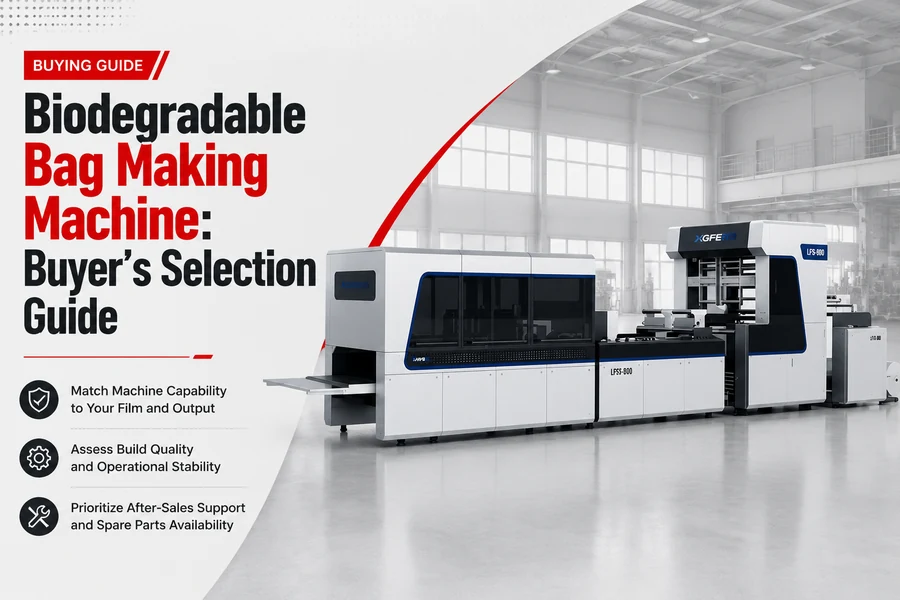
How Should Buyers Choose a Biodegradable Bag Making Machine?
Define the bag style, film formulation, thickness range, and output target before comparing quotes. These operating requirements determine the sealing method, cutting system, and temperature control needed, making it possible to evaluate machines on comparable specifications.
A biodegradable bag making machine is selected by matching the bag style and film blend to a sealing and cutting configuration. The material comparison for t-shirt bag production shows that HDPE offers stiffness, LDPE provides softness and tear resistance, and PLA/PBAT blends deliver compostability but introduce processing challenges. Those differences change the acceptable sealing temperature, dwell time, and knife behavior on the same machine platform.
Start with the product you are converting. Specify whether the bag is a flat bottom-seal bag, a side-seal pouch, a vest-style carrier, or a roll-fed format. Each geometry places different demands on the sealing bar orientation, film path, and cutting unit. For buyers planning a vest-style carrier, the t-shirt bag making machine selection guide can translate dimensions and output expectations into a comparable specification.
- Bag dimensions and tolerance: State width, length, gusset depth, and film thickness range in microns, with the acceptable tolerance for each value.
- Resin blend and film source: Name the polymer or blend and provide a datasheet if available. A machine quoted for HDPE may need a different temperature profile for a PLA/PBAT film.
- Output requirement: Define bags per minute or meters per minute over a working shift, including setup and changeover allowances.
- Seal and cut system: Choose between bottom sealing and side sealing based on the final bag geometry, and between hot-knife, cold-knife, or perforation based on film behavior.
- Changeover plan: If you will run several bag sizes or resins, confirm how long each changeover takes and what operator skill is assumed in that estimate.
Write the criteria into a formal RFQ so every supplier answers the same assumptions. Without this step, quotes can be based on different line speeds, different film thicknesses, or different bag formats, and the final comparison will not reflect your operating needs.
Rank each requirement as mandatory or desirable before opening discussions with suppliers. This ranking prevents a minor feature, such as a remote diagnostic package, from being treated as the same weight as seal quality on your film. It also makes it easier to evaluate trade-off questions when two suppliers propose different configurations.
The film formulation itself should be part of the machine selection, not an afterthought. If you plan to switch suppliers or blends later, tell the machine builder and ask which parameters would need to change. This keeps the machine specification valid beyond the first batch of film.
What Should Buyers Verify Before Ordering a Biodegradable Bag Making Machine?
Verify sealing performance on your resin, documented line speed, cutting behavior, and after-sales support before purchase. Treat supplier promises as provisional until backed by a batch trial on your film formulation, not by quotes calibrated to HDPE or LDPE.
Verification should be built into the RFQ and acceptance stages rather than discovered after installation. The following flow follows the same sequence used in RFQ checklists for bag machines: define the product, agree on material, document performance, and confirm service coverage.
Step 1: Define the Bag and Film Specification
Record the bag width, length, gusset depth, film thickness, and expected thickness tolerance. Attach the resin or blend designation and any supplier datasheet so the machine builder can comment on sealing window and knife wear.
Step 2: Agree on Material and Performance Testing
Ask which materials the machine was demonstrated on, and request a test run using your film blend. The output speed, scrap rate, and seal consistency from that trial are the only figures that should be used for capacity planning.
Step 3: Define Acceptance Criteria
Agree on how a good seal will be judged, how often seals will be sampled, and what film scrap level is acceptable during start-up. Also define the bag length accuracy you need on the cutting unit.
Step 4: Confirm Installation and Service Evidence
Verify the supplier can provide installation supervision, operator training, spare parts, and remote diagnostics. Ask for response-time commitments and for references that run similar biodegradable films.
Where possible, negotiate a factory acceptance test before shipment. The test should use the actual film blend, bag dimensions, and line speed agreed in the RFQ. Photos and videos are supporting evidence, not a substitute for a test on your material.
Documented evidence should include the name of the film, the machine settings used, the measured bag length, the line speed, and the scrap rate during the trial. If the supplier cannot provide those details, treat the performance as unverified. You can also ask for a recording of the trial run so the same settings can be checked during commissioning.
When the technical review is complete, move to the cost comparison using the plastic bag making machine cost procurement checklist.
Which Biodegradable Bag Making Machine Trade-Offs Matter Most?
The key trade-offs are throughput versus film processability, sealing geometry versus bag format flexibility, and automation level versus operator complexity. There is no universal winner; the right balance depends on your film blend, product mix, and maintenance capability.
Trade-offs are not necessarily defects; they are constraints you should calculate against your actual production plan. The table below summarizes where the decision pressure appears and what evidence closes the gap.
| Decision area | What changes | What to validate |
|---|---|---|
| Sealing temperature window | PLA/PBAT blends can be more sensitive to temperature and dwell time than HDPE or LDPE, which affects seal continuity and start-up scrap. | Request a seal trial on your resin blend and record the working temperature and dwell range. |
| Line speed | Higher speed raises output but can shorten sealing dwell and increase adhesion on softer films. | Ask for speed figures measured with your film, not with a conventional polyolefin. |
| Automation level | Servo-driven systems improve repeatability but require trained operators and a clear spare-parts plan. | Confirm operator training scope, remote diagnostics, and response-time commitment. |
| Bag format flexibility | Bottom sealing suits flat bags and carriers; side sealing suits pouches and gusseted bags; changing formats takes time and can affect scrap. | Map your format change frequency against setup time observed in a demonstration or trial. |
Use the table as a scoring sheet by assigning your own weight to each row. For a high-volume single-format operation, line speed and sealing temperature window will dominate. For a job-shop converting several polymers, bag format flexibility and changeover time will matter more. The score should reflect your production mix, not the supplier's preferred configuration.
A frequent trade-off is throughput versus format flexibility. In practice, a dedicated machine may run faster for a single format, but it creates downtime every time the product mix changes. Budget for changeover labor and rejected film as part of the comparison.
The same reasoning applies to material. HDPE and LDPE are established inputs for conventional bag machines, while a biodegradable or compostable blend may require a narrower operating window. If your line has to alternate between conventional and biodegradable film, add resin changeover and cleaning to the evaluation. For continuous rolls of perforated product, review the key specifications and applications for bags on roll making machines before deciding on winding and perforation systems.
For example, a hypothetical buyer moving from HDPE carriers to a PLA/PBAT blend should confirm that the temperature control can hold a narrow window at production speed. Another hypothetical buyer running both conventional and biodegradable film may value fast resin changeover more than peak throughput. Both assumptions should be tested with a documented trial before order.
FAQ
Can the same machine run HDPE, LDPE, and PLA/PBAT blends?
Within limits, yes, but each resin changes the sealing temperature, dwell time, and knife behavior. Ask the supplier for a documented trial on the specific blend you plan to use, and do not assume that a machine quoted for HDPE will hold the same speed on a biodegradable film.
What film specifications should I include in the RFQ?
List bag width, length, gusset depth if needed, film thickness in microns, and the resin blend or datasheet. State the acceptable tolerance for thickness and seal position. This makes supplier quotes comparable and helps avoid hidden add-ons later.
Is a double-line configuration better for biodegradable film?
Not automatically. Double-line platforms increase output per floor space, but biodegradable film can behave differently across lanes, and changeover and control complexity rise. Base the decision on documented single-lane and multi-lane performance with your film rather than assumed bag-per-minute figures.
Conclusion
Choosing a biodegradable bag making machine starts with your bag format, film formulation, and output plan, then moves to documented evidence. Define specifications before the RFQ, verify sealing and speed on your resin, and treat trade-offs such as throughput versus flexibility as calculated constraints. This sequence reduces the risk of ordering a machine that cannot run your intended material at the required volume.