EN
EN
 ES
ES
 AR
AR


Article Overview: This procurement checklist guides decision-makers through evaluating plastic bag making machine cost, understanding price drivers, comparing suppliers, and managing total cost of ownership. Use this structured approach to reduce selection risk and align your investment with production goals. The article covers technical factors, cost comparisons, hidden expenses, and actionable steps to optimize your purchasing process.
What Factors Drive Plastic Bag Making Machine Cost?
Understanding the key drivers of plastic bag making machine cost helps buyers move beyond the base price and evaluate long-term value. The following elements significantly influence both upfront and ongoing expenses.
- Machine type and automation level: Entry-level machines with basic servo control cost less upfront but may have lower output and higher labor requirements. Fully automated servo-driven lines increase plastic bag making machine cost but improve speed, consistency, and energy efficiency. For example, a semi-automatic machine might run 50 bags per minute, while a high-speed servo line can exceed 200 bags per minute, drastically reducing per-unit cost.
- Bag configuration and material: Machines designed for single-line bags, T-shirt bags, or bags-on-roll have different engineering requirements. Customization for biodegradable or heavy-duty materials adds to the price. A standard LDPE bag machine may cost $15,000–$30,000, whereas a biodegradable-capable line can reach $60,000+ due to extra temperature controls and screw design.
- Output speed and width: Higher speed and wider web width directly raise machine cost but also reduce per-unit production cost. A 1000 mm wide machine with 200 cycles/min will be more expensive than a 500 mm, 120 cycles/min model. However, the faster machine can double throughput, lowering the cost per bag over time.
- Brand and origin: Established manufacturers with global service networks often charge a premium. However, this may be offset by lower downtime, better support, and readily available spare parts. For instance, a European brand might cost 30% more but offer 24/7 remote assistance and a 2-year warranty.
- Warranty and spare parts availability: Longer warranty periods and readily available components reduce total cost of ownership but are reflected in the initial price. A comprehensive 3-year warranty versus a standard 1-year can add 5–10% to the upfront cost.
How to Compare Plastic Bag Making Machine Price Across Suppliers?
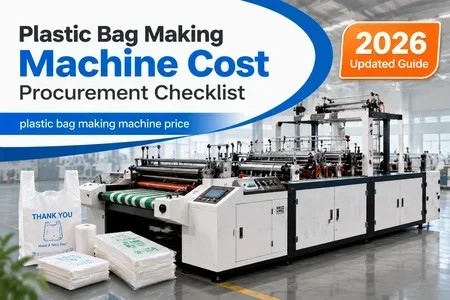
Comparing plastic bag making machine price requires a structured approach to ensure you are evaluating apples-to-apples offers. Use the following checklist when reviewing quotations from multiple suppliers. This process helps uncover hidden differences that affect the true cost.
- Get detailed specifications: Request full technical data including motor power, control system, production speed, material compatibility, and electrical requirements. Without this, price comparisons are meaningless.
- Compare total cost of ownership (TCO): Include installation, training, energy consumption, maintenance, spare parts, and expected lifespan over a 5-year horizon. A machine with 10% higher electricity efficiency may save thousands annually.
- Ask for performance guarantees: Reputable suppliers will commit to output rates and scrap percentages. For example, guarantee 95% uptime or less than 2% waste during normal operation.
- Request reference lines: Visit existing installations or request video proof of similar machines running your target bag type. This validates performance claims and reveals real-world reliability.
- Negotiate payment terms: Flexible milestones (e.g., 30% deposit, 40% at shipment, 30% after acceptance) can reduce financial risk without increasing net cost. Also consider letters of credit for large sums.
When evaluating plastic bag making machine cost for T-shirt bag production, ensure the supplier provides sample output data for your specific bag dimensions and material. A machine optimized for T-shirt bags may not perform equally well for bottom-seal bags, so focus quotes on your primary product line.
Step-by-Step Procurement Process for Bag Making Machines
Phase 1: Requirements Definition
Define bag dimensions (width, length, gusset), material types (LDPE, HDPE, biodegradable), production volume per shift, and automation expectations. Determine if you need multi-line capability or single-lane output. This phase determines which machine categories are suitable and sets a realistic budget for plastic bag making machine cost. For example, a buyer wanting 1 million T-shirt bags per month with 2 shifts will need a different machine than a startup producing 200,000 bags monthly.
Phase 2: Supplier Shortlisting
Identify 3–5 manufacturers that match your technical requirements. Review their product lines, client testimonials, and after-sales service coverage. Use the comparison checklist from the previous section to evaluate their plastic bag making machine cost offers. Request a detailed quotation that includes all line items: machine base price, servo drives, control system, die sets, and shipping. Eliminate any supplier unwilling to provide a breakdown.
Phase 3: Technical Validation
Before committing, verify technical claims through trial runs or third-party inspection. Ask for a test of your actual material and bag design. Check that the machine can handle your desired speed without excessive scrap. Also confirm that the control software supports future upgrades, such as adding a printing unit. This step avoids costly surprises after delivery.
What Are the Hidden Costs in Plastic Bag Making Machine Price?
Beyond the quoted price, several hidden costs affect the total investment. Buyers often overlook these items when budgeting, leading to overspending by 20–30%. Here are the most common areas to investigate.
- Shipping and customs: International shipments add freight, insurance, and import duties. Confirm incoterms (e.g., FOB, CIF) with each supplier. For a $50,000 machine, shipping may cost $2,000–$5,000 plus 5–10% duties.
- Installation and commissioning: Some suppliers include on-site setup; others charge extra (often $2,000–$8,000 per day). Skilled labor may be needed for electrical and mechanical alignment. Budget for at least one week of installation.
- Operator training: Proper training reduces scrap and increases efficiency. Budget for travel, accommodation, or remote session fees. A 3-day on-site training program can cost $1,500–$4,000.
- Tooling and ancillary equipment: Dies, printing units, bag folding tables, and conveyor belts often cost extra. A set of sealing dies for a new bag size may run $500–$2,000 each.
- Maintenance and consumables: Plan for routine part replacements: sealing bars, blades, bearings, belts. Spare parts budget should be 3–5% of machine cost annually. Also factor in energy costs; a 10 kW motor running 16 hours/day at $0.10/kWh adds $5,840 per year.
To avoid surprises, request a total landed cost estimate from each supplier, including all above items. This will give a true comparison of plastic bag making machine price for your facility.
How to Reduce Total Cost of Ownership?
Lowering TCO starts with selecting the right machine for your specific application requirements. Then apply the following strategies to minimize long-term expenses.
- Match machine capacity to demand: Oversized machines waste capital and energy; undersized ones limit growth. Use production planning to pinpoint the ideal output range.
- Invest in energy-efficient drives: Servo motors and inverter controls reduce electricity costs, which often exceed the initial machine cost over a few years. For example, replacing a standard AC motor with a servo can cut energy use by 30%.
- Standardize on one supplier: Consolidating spare parts and service contracts can lower long-term costs. A single-source agreement may yield 10–15% discounts on consumables.
- Negotiate a preventive maintenance plan: Regular servicing extends equipment life and avoids costly breakdowns. Include this in the initial contract for predictable pricing.
- Train operators thoroughly: Well-trained staff reduce scrap, handle machine adjustments correctly, and perform basic maintenance. Invest in initial and refresher training.
These approaches ensure that the plastic bag making machine cost you pay today translates into reliable, profitable production for years. For example, a plant that invested in a high-efficiency servo machine saw a 25% drop in per-unit cost within two years, despite a 15% higher purchase price.
FAQ
What is the typical price range for a plastic bag making machine?
Entry-level machines start around $10,000–$30,000, while high-speed servo lines can exceed $100,000. The exact plastic bag making machine cost depends on speed, automation, bag type, and material compatibility. For a standard T-shirt bag machine, expect $20,000–$50,000.
How can I verify if a supplier's price is fair?
Compare quotes from multiple suppliers using a standardized specification sheet. Request a breakdown of labor, materials, and overhead. Also check application-specific case studies from the plastic bag making machine cost resources to see what other buyers paid for similar configurations. Use third-party inspection if possible.
Should I buy a used machine to save on plastic bag making machine cost?
Used machines have lower upfront cost (often 40–60% of new) but risk higher downtime, obsolete controls, and lack of warranty. Evaluate the total cost of ownership carefully: include estimated repair costs, lost production time, and potential efficiency losses. For high-volume operations, a new machine often pays off within 2–3 years.
What payment structure is common in the industry?
Typical terms are 30% deposit, 60% before shipment, and 10% after acceptance. Some suppliers offer letters of credit or flexible milestones for large orders. Negotiate based on your risk tolerance and supplier credibility.
How do I estimate the payback period for a new machine?
Calculate annual savings from increased output, reduced labor, and lower energy consumption compared to your current process. Divide the net machine cost (after subtracting any trade-in) by the annual savings. A typical payback period is 12–24 months for high-efficiency lines.
Conclusion
Evaluating plastic bag making machine cost requires a clear procurement framework focused on total cost of ownership, not just the purchase price. Start by defining your production requirements precisely, then shortlist suppliers who offer transparent pricing and reliable after-sales support. Use the step-by-step process and comparison checklists in this article to structure your decision. Remember to factor in hidden costs such as shipping, installation, training, and energy consumption. By following this procurement checklist, you can make an informed investment that delivers efficient production, lower per-unit costs, and a competitive edge in your market. Begin your evaluation today by requesting detailed quotations and reference visits from at least three manufacturers.