EN
EN
 ES
ES
 AR
AR


Article Overview: This guide is written for procurement teams, engineering managers, and operations leaders evaluating a plastic bag making machine manufacturer. It answers three questions: which requirements to document before first contact, how to compare supplier fit across technical and service dimensions, and what traceable evidence to request before approval. The conclusion is that a documented operating envelope, one identical RFQ, and a film-specific acceptance run narrow the shortlist more reliably than catalog claims. Evidence comes from published bag machine comparisons and RFQ guidance on this site, and every figure should be re-verified for the specific project.
What Should Buyers Document First Before Contacting a Plastic Bag Making Machine Manufacturer?
Buyers should first document bag style and dimensions, film type and thickness, required output per shift, available floor space and utilities, and an agreed acceptance test that defines a pass or fail result.
That list is short, but it separates comparable quotations from incomparable ones. When a request names only a general machine type, each supplier fills the gap with its own assumptions about bag size, film, and speed.
- Product definition
- Bag style, whether T-shirt or vest, side seal, bottom seal, or bags on roll, plus width, length, gusset depth, and handle or perforation features. Sealing and cutting mechanism defines the machine category, so bag style narrows the machine type first.
- Film specification
- Resin family such as HDPE, LDPE, or a PLA/PBAT blend, thickness in micron or mil with a tolerance band, and roll core diameter. Published material on this site notes that these resins differ in seal temperature, knife adhesion behavior, and achievable line speed.
- Operating envelope
- Smallest and largest bag sizes, expected changeovers per shift, ambient conditions, and available power, compressed air, and floor area.
- Output and acceptance criteria
- Target bags per hour or per shift, plus the verification method: film, bag size, run duration, and acceptable reject rate.
One relationship helps check whether a quoted speed is sufficient: Rreq = Qtarget ÷ (Havailable × E). Rreq is the required machine rate in bags per hour, Qtarget is the quantity of good bags required in the period, Havailable is productive hours in that period, and E is a dimensionless efficiency factor between 0 and 1 covering changeovers, jams, and breaks.
Replace assumed values with measured ones, and label any remaining assumption as hypothetical until a run confirms it. As an explicitly hypothetical illustration, a plant needing 10,000 good bags in an eight-hour shift with an assumed efficiency factor of 0.85 would need roughly 1,470 bags per hour; both inputs are illustrative, and the efficiency factor must come from that plant's own operating records.
Dimension, thickness, and tolerance are the first inputs in the RFQ guidance collected in the bag machine selection guides on the Lingfeng Machinery blog, because they constrain sealing and cutting configuration before any commercial discussion begins.
How Should Teams Compare Supplier Fit Across Technical and Service Dimensions?
Teams should compare suppliers on one weighted set: machine configuration and film compatibility, changeover and maintenance requirements, spare-part availability, installation and training scope, and documented reference runs.
A comparison is only useful when every candidate answers the same questions from the same document types. One matrix per supplier, built from drawings, control specifications, and run records rather than sales presentations, keeps the shortlist defensible when a review asks why a candidate was dropped.
| Dimension | Question it answers | Document to compare |
|---|---|---|
| Film compatibility | Can the line seal and cut the films in our mix without retooling? | Run records listing resin, thickness, and line speed |
| Bag size range | Does the quoted configuration cover our smallest and largest bag? | Dimension table plus change-part list per size |
| Changeover and automation | How long does a size change take, and which axes are servo-driven? | Changeover procedure and control specification |
| Output | How many bags per hour at our film and bag size? | Measured run data at the specified bag, not catalog maxima |
| Service and spares | How quickly can sealing bars, knives, and belts reach the plant? | Spare-part list with identification method and lead times |
| Installation and training | Who commissions the line and trains the operators? | Scope of supply listing on-site days and handover items |
Capacity differences between configurations are real, but they should be checked against the film and bag size in question. Published comparison material on this site reports single-line T-shirt bag machines running up to roughly 120 bags per minute and double-line configurations reaching about 200 to 300 bags per minute; those ranges describe typical configurations rather than verified output on every resin.
For an initial screening pass, a comparative guide to top plastic bag making machine manufacturers can help a team build a candidate list, but every claim drawn from it still needs verification against run data on your own film.
What Evidence Should Be Requested Before Approval?
Request traceable specifications, an acceptance test using the buyer's own film, measured output and reject data from a reference run, spare-part lists with stated lead times, and named service contacts for escalation.
Traceability is the test: a specification sheet should carry a document number or revision date, state units and tolerances, and match the configuration actually quoted. Statements about film compatibility, speed, or sealing quality stay claims until a document, a test record, or a named person supports them.
Seal quality deserves its own test record rather than a sentence in a brochure. Ask which parameters the controller logs, whether those logs can be exported, and how seal integrity is demonstrated on the film you intend to run, including the sampling method and failure threshold.
Reference runs carry most weight when they match your bag style, resin, and thickness, so ask for two or three contactable references and the configuration each operates. Put the commercial boundary in writing as well: which spare parts ship with the machine, how parts are identified in the manual, what installation and training include, and who the escalation contact is when a fault stops the line.
Which Trade-Offs Most Often Decide a Bag Machine Purchase?
The decisions that usually decide a purchase are sealing method and bag geometry, single-line versus multi-line output, automation level, and how much changeover flexibility the actual order mix requires.
Single-line configuration
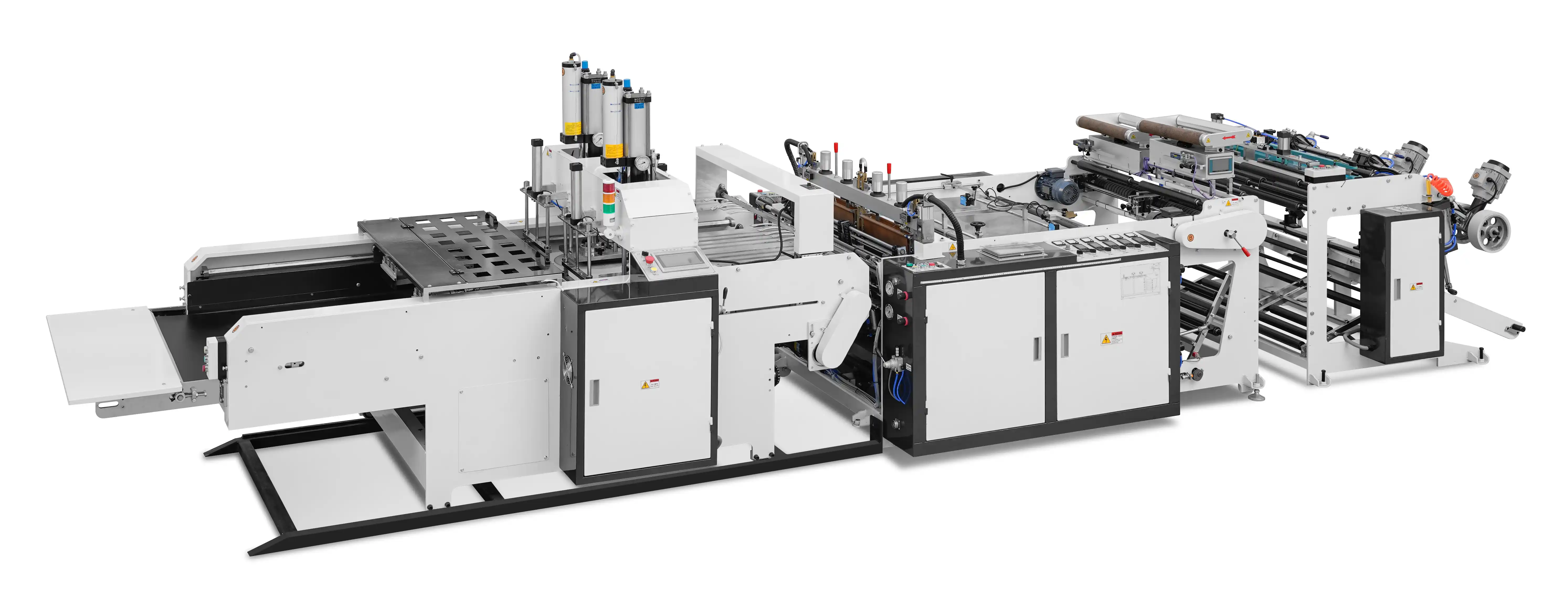
One film path, one bag per cycle, simpler mechanics, and fewer synchronised drives. It suits moderate volumes, frequent size changes, and sites with limited maintenance capacity. Published comparisons on this site place typical single-line T-shirt bag output at up to about 120 bags per minute.
Multi-line configuration
Two lanes run simultaneously with synchronised drives to keep sealing and cutting consistent across both. Output per unit of floor space is higher, but the configuration demands more advanced controls and more operator skill. Published comparisons on this site place typical double-line output at roughly 200 to 300 bags per minute.
Sealing orientation is the other half of the decision because it fixes bag geometry and film path. Teams moving from supplier screening to configuration-level discovery can start with a bottom sealing versus side sealing bag machine comparison, which sets out how seal direction affects bag shape, film handling, film waste, and changeover complexity for flat bags, pouches, and courier mailers.
Automation is often over-specified. Servo-driven axes improve repeatability and reduce manual adjustment, but they add control components a site must be able to diagnose. The practical test is whether the extra automation removes a bottleneck you can name, such as a slow size change or recurring seal deviation.
Sequencing Verification Before Purchase Approval
The sequence below keeps requirement definition, supplier comparison, and evidence verification in a fixed order, so a specification is not quietly rewritten to match the machine a supplier prefers to sell.
Step 1: Freeze the requirement set
Convert the documented product, film, and output requirements into one controlled version. Every supplier then receives the same starting point.
Step 2: Issue one RFQ with the acceptance test attached
Attach the verification method, including film, bag size, duration, and failure thresholds, so offers become comparable and claims become testable.
Step 3: Screen the document pack
Score each supplier against the comparison table using documents only. Weak candidates are removed before travel and testing time is committed.
Step 4: Run the acceptance test
Test with the buyer's film, at the factory or through a reference customer, recording output and rejects. The shortlist then reflects measured performance rather than quoted maxima.
Step 5: Close open points in writing
Resolve spares, training, escalation, and any deviation found in testing as written clarifications, so the purchase order references a verified configuration rather than an assumption.
The sequence is deliberately front-loaded: most findings that change a purchase decision surface during requirement definition and document screening, not during final negotiation.
FAQ
Can a manufacturer's published speed rating be used directly in capacity planning?
Published ratings usually describe an ideal-condition film, bag size, and steady-state run. Treat them as a ceiling, recalculate with your own efficiency factor, and confirm the figure in an acceptance run on your film, where required rate equals target output divided by available hours multiplied by efficiency.
How many suppliers should be shortlisted before an RFQ is issued?
Three to five is a working convention rather than a sourced benchmark, chosen because it shows whether a specification is unusual while keeping document review and run testing comparable. Fewer than three makes it difficult to judge whether a quoted configuration, lead time, or service scope is typical of the market.
Do we need to visit the factory before approving a purchase?
A factory visit helps assess assembly practice, sub-supplier components, and testing under power, but it does not replace a documented acceptance run. Where travel is not feasible, request a walkthrough video, measured run data, and contactable references on comparable bag styles, then record in the evaluation file what could not be verified directly.
What should be written into the acceptance test if we cannot supply our own film?
Specify the closest available resin, thickness, and bag size; state the minimum run duration and sampling frequency; and define pass thresholds for seal integrity, cut accuracy, and reject rate. Ask the supplier to state any film substitution in writing, so results are judged against production film rather than a convenience sample.
Conclusion: Requirements and Evidence Decide the Shortlist
Selecting a plastic bag making machine manufacturer begins as a documentation exercise rather than a negotiation. Buyers who fix bag style, film specification, operating envelope, and acceptance criteria first can issue one RFQ, compare answers on identical dimensions, and test the surviving claims on their own film. Published speed ranges and manufacturer lists are useful for building a candidate set, but they describe typical configurations rather than verified performance at a specific plant. The evidence boundary is the same at approval as at enquiry: if a claim cannot be traced to a document, a measured run, or a named contact, it should be resolved in writing before the purchase order is issued.