EN
EN
 ES
ES
 AR
AR


Article Overview: This guide helps procurement managers and sourcing teams understand bag on roll winding problems and how to mitigate them. It covers common defects, root causes, and a supplier evaluation checklist. Focus is on garbage bag on roll machine problems and selecting equipment that minimizes waste. For a complete solution, explore bag on roll winding problems solution tailored to high-volume production.
What Are the Most Common Bag on Roll Winding Problems?
When sourcing a garbage bag on roll machine, buyers often encounter winding defects that affect product quality and production efficiency. The most frequently reported issues include:
- Loose winding: rolls with varying density, leading to bag tangling or telescoping during unwinding.
- Roll offset: layers shift sideways, creating uneven edges and waste.
- Perforation tear: perforations fail at wrong places or tear easily due to blade wear or tension inconsistency.
- Core instability: the cardboard core deforms or collapses under winding pressure.
These defects are often linked to machine parameters—tension control, dancer arm settings, and perforation blade maintenance. For procurement teams, understanding these problems is the first step toward writing a precise RFQ.
Why Do Winding Problems Occur in Garbage Bag on Roll Machines?
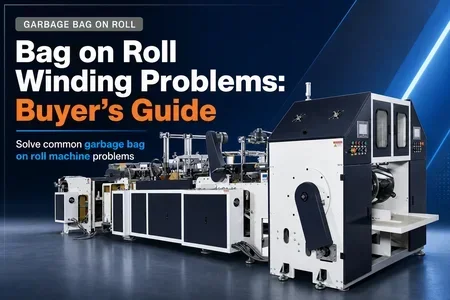
Winding problems stem from both mechanical and process factors. In a bag on roll making machine, the winding section must balance speed, tension, and alignment. Common root causes include:
- Inconsistent film tension: due to worn dancer arm bearings or incorrect PID controller tuning.
- Poor perforation blade quality: dull blades create uneven tear lines that cause roll breakage during winding.
- Misaligned rollers: even a 1 mm misalignment can cause progressive roll offset over a long run.
- Core selection mismatch: using thin-wall cores for heavy-gauge film leads to crush deformation.
Step 1: Document Your Winding Defect History
Before approaching suppliers, collect data on the frequency and type of winding problems you experience. For example, if loose winding occurs on 15% of rolls, note the film thickness and roll diameter. This information helps suppliers tailor their bag on roll winding problems solution.
How to Evaluate Suppliers for Bag on Roll Winding Problems?
Procurement managers should assess potential suppliers on three dimensions: machine design, process control, and after-sales support. Use the checklist below during supplier evaluation and RFQ.
- Ask about tension control architecture: Does the machine use closed-loop dancer arm control with load cells? Inquire if the system compensates for film thickness variations.
- Verify perforation blade life: Request data on blade longevity and change-over time. A blade lasting 500,000 cycles reduces downtime.
- Request roll offset test results: Ask for quality reports showing roll edge alignment tolerances (e.g., ±1 mm for 1000 mm width).
- Check core handling options: Does the supplier offer adjustable core chucks to accommodate different core inner diameters and wall thicknesses?
Step 2: Create an RFQ Template for Bag on Roll Winding Problems
Structure your RFQ to include mandatory machine specifications: winding speed range (e.g., 50–100 rolls/min), tension range (2–30 N), roll core ID options, and certification (CE, ISO). Ask suppliers to provide documented solutions for common garbage bag on roll machine problems they have resolved.
Key Decision Factors When Choosing a Bag on Roll Making Machine
Beyond winding performance, consider these factors that directly impact your return on investment:
Compare: Standard vs. Advanced Winding Systems
Option A: Standard dancer arm with mechanical brake
Low initial cost, but requires frequent manual adjustment. Best for small runs with consistent film quality.
Option B: Servo-driven winding with touchscreen tension presets
Higher upfront investment, but offers automatic compensation for film gauge variation. Ideal for high-volume production of garbage bags on roll.
Buyer note: If your order volume exceeds 50 tons per month, Option B typically pays back within 18 months through waste reduction.
Also evaluate the supplier’s experience with similar applications. A manufacturer that has supplied bag on roll winding problems solutions to multiple clients in your industry will have case studies you can review.
FAQ
What is the most common cause of loose winding in garbage bag on roll machines?
Inconsistent film tension is the primary cause. It can result from a worn dancer arm bearing, incorrect PID settings, or sudden changes in film thickness. Regular calibration and predictive maintenance help mitigate this.
How can I prevent roll offset during winding?
Ensure all rollers are aligned within ≤0.5 mm tolerance. Use edge guide sensors that adjust the winding position in real time. Also, verify that the core is centered before start.
What perforation blade material is best for bag on roll winding problems?
Carbide-tipped blades offer longer life and cleaner cuts compared to hardened steel. For heavy-gauge film, a serrated blade with 10–15 teeth per inch reduces tearing.
Should I buy a machine with a core feeder or manual core loading?
For production speeds above 60 rolls/min, an automatic core feeder reduces operator fatigue and core misalignment. For lower volumes, manual loading may be sufficient.
How important is CE certification for bag on roll making machines?
CE certification indicates compliance with European safety standards. It is mandatory for machines sold in the EU, but also a signal of design rigor and quality control even for non-EU buyers.
Conclusion
Bag on roll winding problems can significantly impact your production efficiency and product quality. By understanding root causes and systematically evaluating suppliers, procurement managers can reduce the risk of machine downtime and waste. Focus on tension control, perforation reliability, and core stability during your supplier selection. Use the RFQ checklist provided here to compare vendors objectively. For further guidance on selecting a bag on roll winding problems solution, consult with experienced manufacturers that specialize in bag on roll making machines.