
Article Overview: Blow up ratio (BUR) is a core process parameter in blown film extrusion that links die geometry, bubble diameter, and final film thickness. This guide explains the definition, calculation, typical ranges, and practical implications for converters and bag makers who depend on consistent film rolls for sealing, cutting, and high-speed bag lines.
Contents
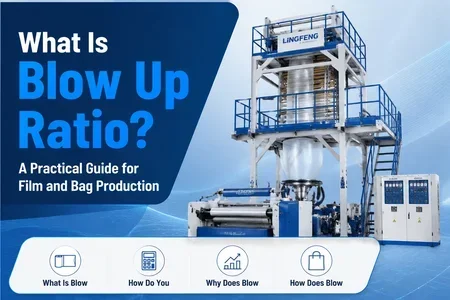
Blow up ratio (BUR), sometimes called the blow ratio or blow-up ratio, describes how much a molten polymer tube is expanded after it leaves the die in a blown film line. In the classic blown film process, polymer is extruded through a circular die to form a thin-walled tube. Air is injected to inflate the tube into a stable bubble, which is then cooled, collapsed, and wound into a roll of lay-flat film.
The blow up ratio expresses the relationship between the expanded bubble and the original die opening. Process engineers use it to predict film gauge, orientation, and width. For bag manufacturers who buy film rolls or run integrated extrusion-to-bag lines, BUR is not an abstract lab number—it influences whether film feeds smoothly into a t-shirt bag making machine, holds seal integrity on a bottom sealing line, or runs at target speed on bags-on-roll equipment.
Although BUR is defined at the extrusion stage, its effects propagate through the entire value chain. A roll that is too thin or too oriented because of an aggressive blow ratio may wrinkle in the unwind stand, drift in registration, or require lower sealing temperatures on a side sealing bag making machine. Understanding BUR helps technical buyers communicate specifications with film suppliers and set realistic expectations for bag line output.
The most common engineering definition compares bubble diameter to die diameter:
BUR = bubble diameter ÷ die diameter
Some plants instead reference the ratio of bubble radius to die radius; the numerical result is the same. Lay-flat width is related to bubble circumference, so once BUR and die diameter are known, you can estimate the finished film width before trim and edge treatment.
Film thickness (gauge) is inversely related to the area expansion implied by BUR, assuming uniform draw and no significant neck-in anomalies. If the die gap and throughput are held constant, increasing BUR generally spreads the same polymer mass over a larger bubble surface, which tends to reduce thickness unless line speed or output is adjusted.
Suppose a line uses a die with an outer lip diameter of 200 mm and the process team stabilizes the bubble at 600 mm diameter. The blow up ratio is:
BUR = 600 mm ÷ 200 mm = 3.0
The lay-flat width is approximately half the bubble circumference (before edge fold and trim):
Lay-flat width ≈ π × bubble diameter ÷ 2 ≈ 942 mm
If the target bag web requires 900 mm usable width after trimming, this bubble setting is in the right ballpark. However, the example also shows why small drift in bubble diameter—caused by cooling air imbalance or frost-line movement—can change effective width and gauge at the winder. Bag lines that run tight width tolerances for shopping bags or t-shirt bags often specify not only nominal gauge but also lay-flat width and roll edge quality.
BUR influences mechanical orientation, optical appearance, and process stability. At moderate ratios, machine-direction and transverse-direction orientation can improve tensile strength and toughness in ways that benefit downstream sealing. At very high ratios, the bubble becomes harder to stabilize; thickness variation, gauge bands, and wrinkling may increase.
Key effects to consider include:
Converters who purchase film rather than extrude in-house should still understand these relationships. When a bag line experiences intermittent seal failures or edge curl, the root cause may trace back to film orientation set during extrusion at a particular blow ratio, not only to sealing parameters on the bag machine.
Bag making machines consume lay-flat film as a continuous web. They depend on consistent gauge, width, coefficient of friction, and thermal behavior. BUR-related film characteristics map to several practical bag-line concerns:
Integrated plants that extrude and convert on one site can tune BUR, resin blend, and bag machine parameters together. Merchant converters should document film specifications—nominal gauge, lay-flat width, resin type, and whether single-layer or coextruded—and validate sample rolls on the actual bag line before scaling orders.
Typical BUR values depend on resin, die design, and product target. Broad industry patterns include:
| Application context | Typical BUR range | Notes for bag makers |
|---|---|---|
| General packaging LDPE/LLDPE | 2.0 – 3.5 | Common for grocery and retail bag film; balance of gauge control and bubble stability. |
| HDPE thin gauge | ~2.0 – 2.8 | Lower ratios sometimes used for stiffness; check seal window on bag lines. |
| Heavy-duty or thicker film | 1.8 – 2.5 | May prioritize gauge uniformity over maximum width per die size. |
| High-clarity or specialty blends | Process-specific | Optical targets may constrain BUR; trial runs recommended. |
These ranges are guidelines, not guarantees. Die gap, melt temperature, cooling ring design, and coextrusion structure all interact with BUR. When specifying film for delivery bags or medical-waste applications, buyers should align BUR-related film properties with seal strength and puncture requirements rather than selecting ratio values in isolation.
No. Blow up ratio compares bubble diameter to die diameter in the transverse direction. Draw down ratio (or draw ratio) typically refers to machine-direction stretching between the die and the nip rolls. Both affect final film properties, but they describe different parts of the process.
Yes. Operators adjust internal bubble air, cooling air, frost-line height, and line speed to change effective bubble diameter while keeping the same die. However, each line has a stable operating window; large changes may require die or resin adjustments.
Not automatically. Thickness depends on mass output relative to expanded bubble area and haul-off speed. Higher BUR tends to spread polymer over a larger area, but extruder output and line speed can compensate.
Because BUR influences gauge uniformity, width, orientation, and seal behavior. Film that meets nominal thickness on average but was extruded with poor BUR control may still cause bag-line downtime, seal rejects, or inconsistent handle strength.
Blow up ratio is a fundamental link between extrusion geometry and the film rolls that feed bag making lines. Defined as bubble diameter divided by die diameter, BUR helps predict lay-flat width, influences orientation and gauge, and shapes how film behaves on sealing, cutting, and winding equipment. For procurement and engineering teams, specifying and validating film with BUR-related process awareness reduces trial-and-error during line commissioning and scale-up.
Whether you extrude in-house or source film externally, align BUR and related film specifications with the bag styles and machines you run—from t-shirt and bottom-seal lines to continuous roll formats. Sample trials on production equipment remain the most reliable way to confirm that extrusion settings and bag machine parameters work together as a system.




 EN
EN
 ES
ES
 AR
AR